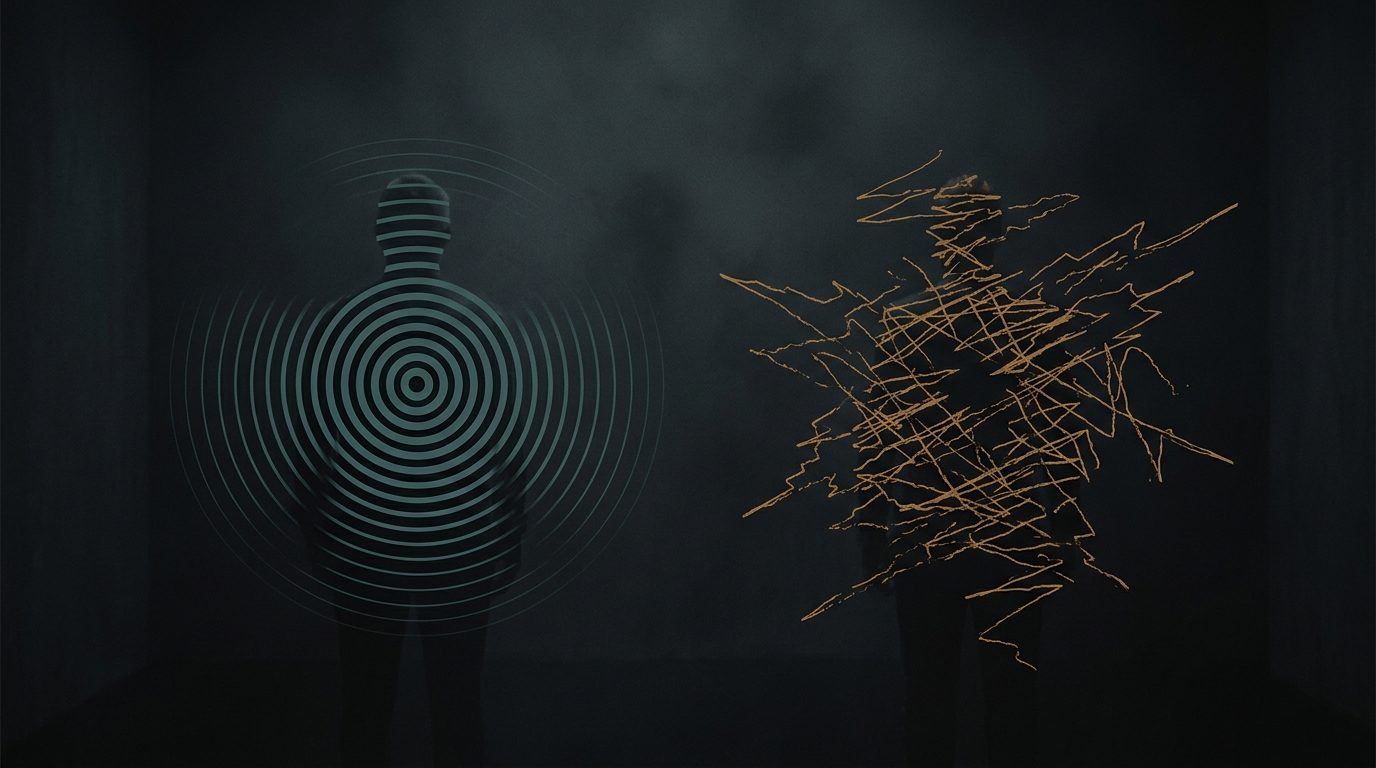
You Feel Coherence, Not Character
You can feel someone before you see or hear them — and you call it a bad person. You are reading something real and naming it wrong. What arrives is not moral information but structural: whether a person is at peace with themselves or at war. The evidence for that turns out to be far better than the mysticism usually attached to it.
Someone you cannot see is walking toward you. They are around a corner, or behind you in a queue, or on the far side of a room you have not yet looked at. You have not heard them speak. And still — something in you has already moved. You would call it a bad feeling. Pressed a little harder, you would probably call it a bad person.
I want to argue three things. That the feeling is real. That you are genuinely reading something. And that what you are reading is almost certainly not what you think it is.
You are receiving an actual signal
Start with the least mystical version, because it is stranger than the mystical one and it has evidence behind it.
Collect sweat from people who have been made afraid. Give it to other people to smell, in a lab, with no context. The receivers' faces begin to make the shape of fear — the specific muscles, measured. Their sniffing deepens. Their eyes widen their scan of the room. They report nothing unusual, and the effect has no relationship to whether they found the smell pleasant. They have caught a state without knowing they caught anything at all. That is de Groot and Semin's chemosignal work, published in Psychological Science, and it means a person's internal condition can travel to your body through a channel you have no conscious access to.
Add to that the synchrony literature: heart rate, heart-rate variability and skin conductance drift into alignment between people who are interacting. Skin-conductance synchrony predicts whether a pair will cooperate successfully. Both predict attraction on blind dates. The findings are genuinely mixed — plenty of null results, heavy context-dependence — but the phenomenon is not in doubt.
Then add thin-slicing. Ambady and Rosenthal showed that thirty seconds of exposure is enough for accurate judgements about personality, deception, trustworthiness, how a relationship will go. Whatever this faculty is, it is fast, it is largely automatic, and it was almost certainly built for deciding whether to approach or run.
So: chemistry, physiology, and a rapid inference engine you do not operate. Three channels, all real, all below awareness. The mystery was never whether you pick people up. That question is settled, and the answer is yes.
The mystery is what you are picking up — and there I think almost everyone, myself included, has been naming it wrong.
Which way does a feeling travel?
The textbook account runs one direction. The brain reads a situation, predicts what it means for you, fires the corresponding chemistry, then reads its own body back and puts a name to the pattern. The same physiological signature becomes fear in one context and excitement in another. The brain is the author; the body is the text.
I think this is upside down, and I am not alone in a way I did not expect.
Mark Solms puts the source of consciousness in the upper brainstem rather than the cortex, and holds that it is fundamentally affective — that consciousness is, at bottom, the felt registration of how the organism is doing. His evidence is hard to wave away: children born with little or no cortex still show emotional response, and destroying about two cubic millimetres of brainstem abolishes consciousness altogether. Feeling is not something consciousness produces. Feeling is what consciousness is made of.
Antonio Damasio runs the same arrow further back. Feelings are the mental expression of homeostasis — the body's business of staying viable — and "the sensing and responding level of perception precedes minds." He traces the imperative to bacteria, four billion years ago. Feeling is older than thinking by an almost comic margin.
Jaak Panksepp spent a career mapping seven primary emotional systems in ancient subcortical structures shared across mammals. Not constructions assembled by a clever cortex. Equipment, inherited.
Three serious people, three vocabularies, one direction: affect is prior, and the cortex is downstream. The brain is not the author of your feeling. It is the interpreter — and, being an interpreter, it is also the part that gets the story wrong.
The narrator arrives late
There is a second thing the interpreter does badly, which is show up on time.
In 2008 Soon, Brass, Heinze and Haynes decoded the content of a free choice from patterns in frontopolar cortex and the precuneus up to seven seconds before the person was aware of choosing — closer to ten, once you account for how sluggish the fMRI signal is. Not "some activity preceded the choice." The actual outcome, readable, while the person still experienced themselves as undecided.
I am deliberately using this study rather than the famous one. Libet's readiness-potential work is the usual citation here, and it no longer holds the weight people put on it: Schurger and colleagues recast the readiness potential as a stochastic accumulator driven by neural noise — a byproduct rather than a decision. The thirty-year headline that Libet disproved free will has to be retired. The Soon result survives that critique, because it decodes which choice rather than measuring a build-up.
The modest conclusion is enough for me. By the time you are conscious of a feeling, the feeling has already happened. You were not present at its origin. You arrive afterwards and write the only account anyone will ever read — and then, because you wrote it, you mistake yourself for the author of the event.
The part I cannot prove
Here is where I go past the evidence, and I want to be exact about where the line is.
My own conviction is that this cascade starts below biology — that there is a pattern-carrying layer beneath the chemistry, and emotion is its expression, not its product. Said out loud in an argument recently, I put it like this: take this as my axiom and act on it. Don't tell me what is already known.
That is a dangerous sentence and it deserves disarming. It is not a request to be agreed with, and it is not permission to stop checking. Every crank in history has said something close to it, and the reason they stayed cranks is that they claimed the exemption and then relaxed. They wanted the freedom of the axiom without the tax on it.
The tax: if you start from something unproven, you owe more rigour afterwards, not less. Write the axiom cleanly enough that it could be wrong. List the phenomena it is supposed to cover. Put the rival explanations beside it rather than out of sight. And answer two questions per claim, not one — not only what would I expect to see if this were true, but what would I expect not to see. A model that survives only the first question is not a model. It is a mood.
So, paying the tax. The quantum end of this is the Penrose–Hameroff line, and it has done better lately than its reputation suggests. Anesthetics appear to act on microtubules inside neurons. The sharpest result: xenon isotopes that carry nuclear spin are weaker anesthetics than spin-free xenon — and nuclear spin should not matter at all if nothing quantum is going on. The standing objection has always been decoherence, the claim that a warm wet brain destroys quantum states instantly. That objection is weaker than it was, because quantum biology is now an ordinary field: photosynthesis exploits room-temperature coherence, and migrating birds navigate by a radical-pair mechanism running on entangled electron spins. Evolution demonstrably does preserve these effects in warm tissue. Bohm's implicate order — reality we perceive unfolding from a deeper enfolded ground, with mind and matter as two aspects of one thing — is the same intuition stated by a physicist of the first rank.
And now the limit, which matters more than any of that. Every one of those results is about consciousness. None of them is about emotion. The step from "microtubules may matter for consciousness" to "emotions originate there" is mine. Nobody I have cited takes it.
Which leads to the thing I did not expect to find when I went looking for support: the rest of the argument does not need this part. Affect being prior, consciousness arriving late, states passing between people, coherence being the variable — every one of those stands on its own literature. The quantum substrate is the one claim carrying no load. It is a question about mechanism, and it can stay open without the building falling down.
The correction that mattered
Now the actual discovery, which was not a finding. It was a word.
I had been calling it good energy and bad energy. The bad kind vibrates — almost shakes — and I can pick it up off people at close range. Say that out loud and you hear what it sounds like. It sounds like a claim to detect evil.
Drop the moral vocabulary and everything changes. Say constructive and destructive. Better: say coherent and incoherent. Then describe what is actually there. The person I read as bad is very often someone who does not know what to do. They are bouncing left, then right, then left again. Something has not gone the way they expected and they have not caught up to it. They are oscillating. They are at war with themselves.
That is not a moral state. It is a structural one — and the moment you name it structurally, the claim stops being an accusation and becomes a hypothesis. I am not detecting whether someone is good. I am detecting whether someone is internally aligned.
Carl Rogers got there in 1957 and I arrived seventy years late. He called it congruence and incongruence: incongruence is a mismatch between a person's self-image and their actual experience, and he identified it as a primary source of internal tension. Congruence he described as an unfeigned, spontaneous genuineness of being. And here is the part that closes the loop — he made therapist congruence one of the necessary conditions of therapeutic change precisely because other people perceive it. The state is detectable. That was clinical doctrine before I was born.
So the sharp form, said plainly enough to be attacked properly: people embody patterns of coherence, other people detect them below awareness, and the mechanism is at least partly known and probably plural. Three separable claims — the state, the signal, the interpretation — each able to fail on its own. Keeping them apart is the entire discipline. Most of what goes wrong with ideas like this is that they fuse into one lump that can only be swallowed whole or spat out.
Two ways to ruin this
Coherence is not virtue. A person can be perfectly integrated and perfectly cruel — the worst people in history were not the ones bouncing left and right. Incoherence is not danger either; it is far more often someone having a bad month. If I let the moral axis and the structural axis collapse back together, I have not built a model. I have built a licence to judge people on a feeling and call it insight. That is the obvious failure mode and the only defence is refusing the collapse every single time.
Coherence is not an emission. The moment I upgrade it from a description of someone's internal state into a field radiating from their chest, I have walked into HeartMath territory — the outfit that claims the heart's electromagnetic field carries emotional information between people, and which is treated as pseudoscience for the specific reason that it asserts coherence is something other than relaxation without ever showing it, and reads noise as signal. Keep coherence descriptive. The moment it becomes a broadcast, the idea inherits that whole graveyard.
I should also name the strongest rival rather than hide it. Lisa Feldman Barrett's constructed-emotion theory explains the late arrival of feeling, the primacy of the body and the subjectivity of experience with no deeper layer at all — emotions assembled predictively from interoception and learned concepts. It is the incumbent, and it is built on Friston's free energy principle, which I had assumed was on my side and is not. Solms is the interesting exception: he takes Friston's framework and reaches the affect-first conclusion anyway. That is the live argument, and I am on the minority side of it.
What survives
Strip out every speculative claim above and one practical thing is left standing, untouched.
If what people register off you is coherence, then the work is not managing how you come across. Not performance, not tone, not the careful arrangement of a face. It is ending the war inside — deciding the thing you have been avoiding deciding, closing the gap between what you do and what you actually believe, stopping the left-right-left.
That holds whether emotion begins in a quantum substrate or in sweat, posture and a fast inference engine. Either way the instruction is identical, and it is not seem better. It is stop oscillating.
The rest is just what other people happen to pick up.
blog.haveThoughts
