All days

Morning Intelligence

YouTube feed · Monday, July 20, 2026

12 of 80 recommendations summarized

Science

We've never seen an atom. But we know what they look like.

We've never seen an atom. But we know what they look like.

Be Smart · 18:28

Traces the full history of atomic theory from Democritus to quantum mechanics, explaining why visible light physically cannot resolve individual atoms and walking through every imaging technique we've tried (X-rays, electron microscopes, STM, ion traps, Cornell's 2021 electron ptychography). Culminates in the quantum measurement problem: electrons exist as probability clouds, and observing an atom changes its behavior, so what it 'looks like' unobserved may be unanswerable. Explains how macroscopic visibility emerges from collective electron seas despite individual atoms being invisible.

Alösha's take: Solid PBS deep-dive connecting quantum weirdness to the philosophy of observation — right at the intersection of science and 'what is reality' questions.

Первый сигнал от горизонта чёрной дыры | Пушка Космос

Первый сигнал от горизонта чёрной дыры | Пушка Космос

SciOne · 25:47

Russian science channel SciOne covers what appears to be a breakthrough detection or observation related to black hole event horizons — likely discussing new data from instruments like the Event Horizon Telescope or gravitational wave detectors that provide direct information from near the horizon boundary.

Alösha's take: Solid deep-dive on black hole physics from a reliable Russian sci channel — worth it if you're in the mood for astrophysics in Russian.

We Actually Have a Third Eye (And It’s Not Metaphysical)

We Actually Have a Third Eye (And It’s Not Metaphysical)

Anton Petrov · 17:18

Anton Petrov breaks down a recent study tracing vertebrate eye evolution back 600 million years to a worm-like ancestor that had both lateral eyes and a central midline eye. After a sedentary filter-feeding phase caused lateral eyes to atrophy, the midline eye later re-split into paired eyes — explaining why vertebrate retinas are 'inverted' compared to octopus eyes. The pineal gland is the remnant of that original third eye, still containing photoreceptive pinealocytes identical to retinal cells.

Alösha's take: Genuinely mind-bending evolutionary story — the pineal gland as a literal vestigial eye, not mystical woo, backed by comparative anatomy across 36 animal groups.

Apple / AI Hardware

I hope you already own a Macbook...

I hope you already own a Macbook...

Theo - t3․gg · 22:43

Theo breaks down Apple's steep RAM-driven price hikes (a maxed M5 MacBook went from ~$7K to ~$10K) and explains why Macs remain uniquely valuable for local AI inference: unified memory lets the GPU access all system RAM, enabling 60GB+ models like GPT-OSS-120B at ~100 tok/s. Compares alternatives (Framework Desktop with AMD Strix, Nvidia DGX Spark) and explains the NAND flash supply crisis caused by Nvidia/GPU demand squeezing consumer RAM and SSD prices.

Alösha's take: Practical breakdown of whether Macs still make sense for local model inference after the price hikes — directly relevant if you're running models on your MacBook.

Consciousness / Philosophy

Is This the New Theory for God?

Is This the New Theory for God?

More Alex O'Connor · 8:37

Bernardo Kastrup explains how analytic idealism — the view that reality is one universal field of subjectivity — naturally leads to something resembling God: omniscient, omnipresent, omnipotent, but non-deliberate and non-judging. He speculates the primordial impetus could be an instinctive drive toward self-knowledge or the unbearability of sheer solitude, while cautioning against anthropomorphizing this 'mind of nature.'

Alösha's take: Kastrup finally says the quiet part out loud — idealism converges on pantheism — and the careful disclaimers make this more honest than most God-talk.

Why Escaping Pain Keeps You Asleep | Ramana Maharshi

Why Escaping Pain Keeps You Asleep | Ramana Maharshi

Eternal Life | Non-Duality · 4:32

Narrated summary of Ramana Maharshi's teaching on pain and self-inquiry: suffering is not a flaw to eliminate but the ego's friction against reality. Instead of numbing or outthinking pain, turn attention inward with 'To whom does this pain arise?' — resistance feeds the ego, while observation without narrative dissolves the false sufferer and reveals unconditioned awareness.

Alösha's take: Clean 4-min distillation of Maharshi's self-inquiry method — good refresher if you're into non-duality, though nothing new if you've read 'Be As You Are'.

Why You Have NO MOTIVATION Left After Spiritual Awakening – Carl Jung Explains

Why You Have NO MOTIVATION Left After Spiritual Awakening – Carl Jung Explains

Psyrena · 21:01

Explores Carl Jung's framework for the post-awakening 'void' — the nigredo phase where ego-driven motivation dissolves before the Self emerges. Covers individuation, enantiodromia (extreme-to-opposite reversal), shadow integration, and why culture pathologizes the liminal stillness between ego collapse and authentic selfhood. Argues demotivation after awakening is chrysalis, not regression.

Alösha's take: Solid Jungian deep-dive on the psychology of ego death and individuation — worth it if you're into consciousness and inner transformation, despite the self-help packaging.

Consciousness / Physics

10 Terrifying Reasons Scientists Now Think Consciousness Breaks Physics

10 Terrifying Reasons Scientists Now Think Consciousness Breaks Physics

Space Buddy · 18:09

Pop-science compilation covering 10 open problems where consciousness intersects physics: the measurement problem and observer dependence, Wigner's friend 2019 confirmation (two mutually exclusive valid observations), Libet's readiness-potential gap before conscious decision, anesthesia's unknown mechanism, the binding problem, split-brain dual agency, NDE recall during flatline EEG (van Lommel's Lancet study), IIT's panpsychism implication via phi, and Chalmers' hard problem. Each cites actual papers and researchers.

Alösha's take: Solid 18-minute refresher on the biggest unsolved consciousness puzzles — clickbait title aside, the actual citations (Proietti 2019, Tononi's phi, van Lommel in The Lancet) make it a decent primer if you haven't revisited these in a while.

AI / Anthropic

The most controversial rewrite in history just shipped...

The most controversial rewrite in history just shipped...

Fireship · 5:52

Bun (acquired by Anthropic) used 64 parallel Claude agents to port 535K lines of Zig to Rust in 11 days for ~$165K equivalent spend, fixing 128 bugs and shrinking binaries 20%. Zig creator Andrew Kelly fired back claiming benchmarks are misleading and Bun's Zig code was always bad. Video breaks down the technical motivations (memory safety, AI-writability) and the adversarial reviewer pattern used to keep agents honest.

Alösha's take: Claude agents mass-rewriting a production codebase in 11 days — this is the clearest signal yet of where Anthropic is taking code agents at scale.

AI / Machine Learning

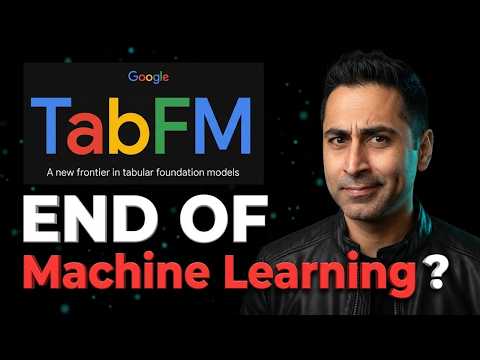
Google TabFM: The AI Breakthrough That's About to Replace Traditional ML

Google TabFM: The AI Breakthrough That's About to Replace Traditional ML

AI with Surya · 7:16

Google's TabFM is a foundation model for tabular data that performs zero-shot classification/regression without training, beating tuned XGBoost models. It uses a novel two-way attention mechanism (column attention → row compression → ICL transformer) treating labeled rows as context and unlabeled as queries — essentially in-context learning for spreadsheets. The presenter argues it eliminates the baseline-building phase (feature engineering, model selection, tuning) but not the harder problems of data quality and error-cost analysis.

Alösha's take: Interesting architectural twist — transformers reading tables in both dimensions. The 'floor came up, ceiling didn't move' framing is the right nuance for anyone building ML pipelines.

Consciousness / Simulation

We Might Be The EXPERIMENT. The Sumerian Texts Said This 4000 YEARS AGO.

We Might Be The EXPERIMENT. The Sumerian Texts Said This 4000 YEARS AGO.

The Archivist's Journal · 12:32

Examines Human Accelerated Regions (HARs) — 3,171 DNA sequences conserved for 300M+ years across vertebrates that rapidly mutated only in humans, primarily in brain-development genes. Draws parallels to the Sumerian Atrahasis Epic's description of Anunnaki engineering humans through trial-and-error hybridization. Also covers chromosome 2 fusion and the unexplained 200,000-year gap between anatomically modern humans and the sudden cognitive revolution ~50-70k years ago.

Alösha's take: The HARs research is legit and fascinating — ancient astronaut framing aside, the question of why conserved sequences suddenly rewrote themselves only in our lineage is genuinely hard to dismiss.

AI / Local LLMs

Dev Workloads and LLMs… under $1000

Dev Workloads and LLMs… under $1000

Alex Ziskind · 21:08

Review of GeekCom A9 Max mini PC (AMD Ryzen AI 9 HX370, upgradeable to 128GB RAM) under $1000. Benchmarks developer workloads (NX monorepo builds, .NET compilation, web tooling) against Mac Mini M4/M4 Pro, then tests local LLMs via LM Studio — GPT OSS 20B gets ~13 tok/s with limited GPU offload due to only 4.5GB dedicated VRAM on the integrated Radeon 890M.

Alösha's take: Useful if you're considering a budget local-LLM box — the upgradeable RAM is tempting but the GPU bottleneck is real compared to Apple Silicon's unified memory.

home.newsletter.title

home.newsletter.valueProp

Alösha

© 2026 Alösha. footer.allRightsReserved

|footer.privacy|