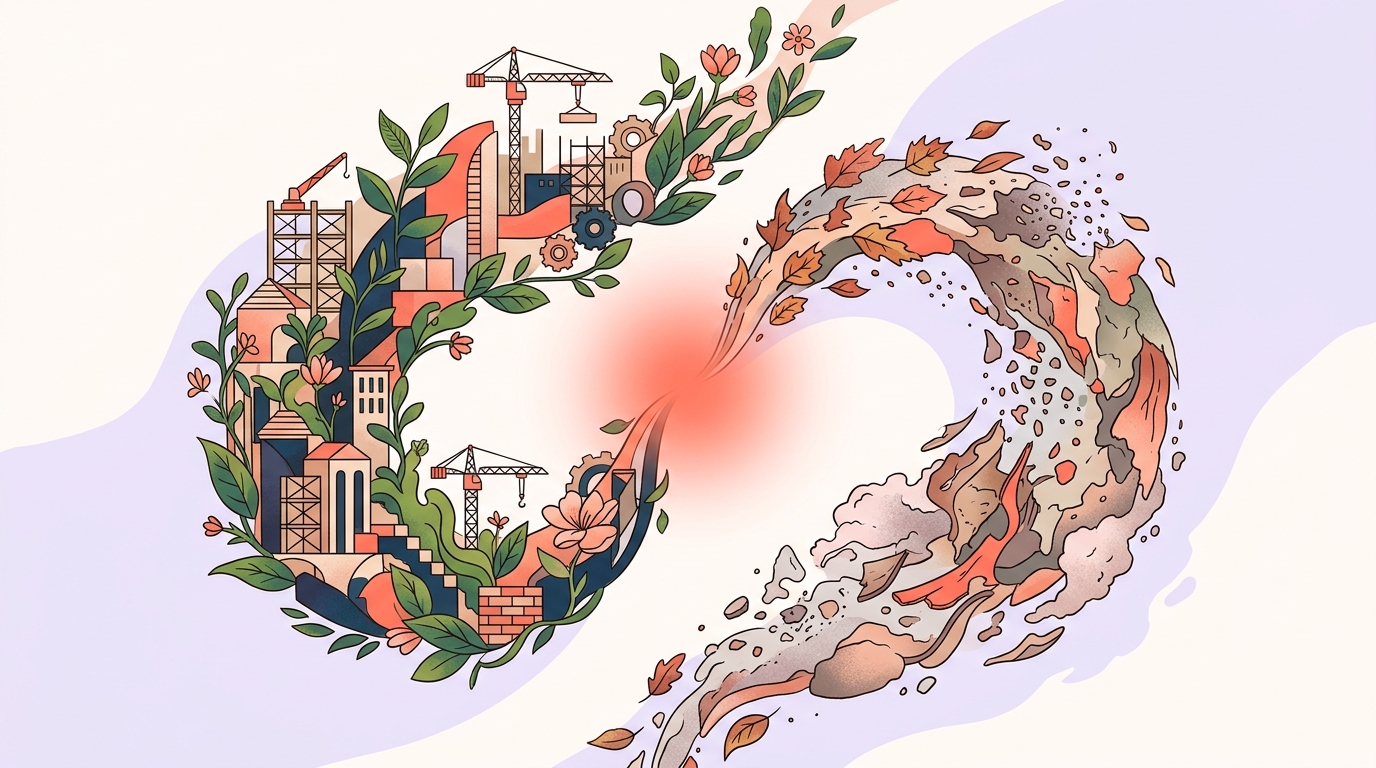
Construction and Destruction: The Two Forces Behind Every Idea That Becomes Real
Every act of creation is also an act of destruction. Most people only celebrate the building. The other half is silent but always present.
I keep noticing the same pattern in everything I ship: nothing gets built without something else getting torn down.
The quantum world has two aspects that physicists describe as construction and destruction. Some philosophies call it yin and yang, some call it male and female energy, some call it the wave and the void. I'm not attached to any of those labels. What I care about is the mechanic underneath: an idea forms in one place, and the moment it materializes somewhere else, it consumes whatever was occupying that space before. Both directions are always running. We just refuse to look at one of them.
The half nobody puts in the launch tweet
When I shipped the first version of WeDance, I wrote a long thread about what we built. I did not write a single line about what it killed.
It killed my evenings. It killed a friendship that had been coasting on shared free time. It killed an alternative path I was quietly considering. It killed the version of me who could still claim he was "just exploring." None of that is bad. It's just true. The shipping of the thing destroyed the not-shipping of the thing, and the not-shipping had its own life, its own people, its own future. That future is gone now. I built over it.
Every founder I respect has a similar shadow ledger. They don't talk about it because the construction side is what gets retweeted. The destruction side feels like complaining, or like admitting weakness. So we edit it out. Then every new project feels harder than expected — we keep budgeting for the build and forgetting to budget for what the build consumes.
Code is the cleanest example
If you've ever shipped a feature, you know this in your hands.
You add a flag. It changes a function called from forty places. Some adapted, some broke silently, some were workarounds for the absence of the thing you just added — and those workarounds are dead weight, but nobody has the courage to delete them yet, because deletion feels destructive.
That's the moment most engineers freeze. They've been trained to construct. They have not been trained to destroy with the same care.
The seniors I learn from delete more than they write. They look at a pull request and ask: what is this making redundant? What old assumption are we now allowed to bury? They treat destruction as a craft, not a regret. The codebase shrinks under their hands and gets stronger. The ones on the construction-only diet leave behind code that grows like a city without a sanitation system.
Products destroy the workarounds users built
When you ship a feature that solves a real pain, you also kill the entire scaffolding people had built around the absence of that feature. The spreadsheet someone maintained for three years. The Slack channel someone created to coordinate. The intern someone hired to do the manual version. The mental model your power users had carefully constructed about how your product behaves.
Some of them will thank you. Some of them will be furious — not because your feature is bad, but because you erased the thing they were proud of. Their workaround was their craft. You walked in and made it irrelevant.
This is why "we listened to feedback and shipped the thing!" announcements sometimes land worse than expected. You delivered construction. The user is metabolizing destruction. Both are real. Acknowledge both.
Relationships work the same way
Saying yes to one person quietly says no to everyone you didn't choose. Moving in together destroys the version of life where you both still had your own space, your own routines, your own untranslated languages. Getting clear about what you want from a partnership destroys the polite ambiguity that was, until that moment, doing all the diplomatic work.
Healthy relationships do not avoid this destruction. They name it. The mature move isn't pretending nothing has been given up — it's acknowledging the cost out loud, together, so the construction can stand on honest ground instead of on suppressed grief.
The relationships I've watched fall apart didn't fail because of the thing that was built. They failed because nobody would name the thing that had been killed to build it.
How I try to use this
I started running every meaningful decision through both lenses.
When I plan a new feature, I write down what it will construct — and on the same page, what it will destroy. Old code paths. User habits. Internal assumptions. My free hours. The simpler version of the product. Sometimes the destruction column is heavy enough to reframe the decision: ship a smaller version, or ship it but explicitly mourn what it replaces.
When I commit to something — a partnership, a project, a relationship — I try to name the thing on the other side of that commitment. The path I'm closing. The optionality I'm spending. Not to talk myself out of it. The opposite: to honor that the choice is real. A yes that doesn't notice what it's killing isn't really a yes; it's a vague hope.
When I look at someone else's work, I try to read it with both eyes too. What did they build? What did building it cost them, and what did it cost the thing that came before? Most of the interesting story lives in the second column.
The neutral truth
Destruction is not a moral failure. It's not the dark twin of creation, the sin that follows the virtue. It's the other half of the same act. You cannot pour water into a glass without displacing the air that was there. You cannot start a company without ending the version of your time that wasn't running one. You cannot love someone without unmaking the smaller life you had when you didn't.
The reason I'm writing this down is that I notice how often I forget. I get excited about the thing I'm constructing and pretend the rest is free. It isn't free. It never was. And the more I treat construction and destruction as one motion instead of two — like inhale and exhale, like the two sides of the same wave — the less brittle the things I build become.
The idea forms somewhere. Then it materializes here. And in the gap between those two verbs, something else has to make room.
That's the whole job.
Join the discussion on Telegram!

Alösha
Building community platforms, teaching salsa, writing to find my people.