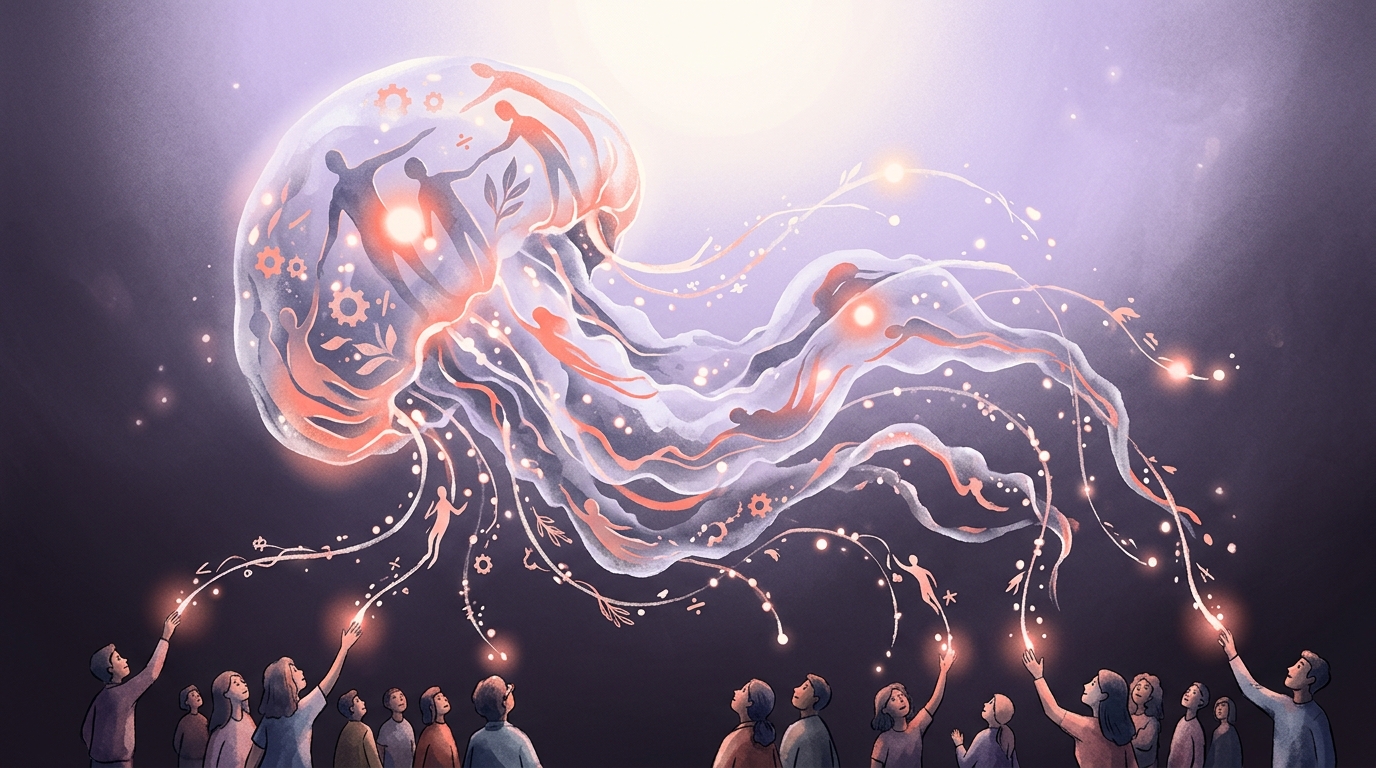
Egregores Are Living Organisms — Just Not the Kind You Can Touch
Brands, religions, programming languages — egregores meet every honest definition of life. They just live in a dimension our hands can't reach.
I keep coming back to a sentence I said out loud once and couldn't take back: an egregore is actually a living organism. Not a metaphor. Not "kind of like" a living thing. A real organism — just one that lives in a dimension where you can't poke it with a finger.
That sounds fringe at first. So let me walk through it the way I'd walk through any hypothesis: definitions, evidence, edge cases, and where the analogy breaks.
Start with what "alive" actually means
Biology gives us a working definition of life through a handful of properties. An organism has a boundary. It maintains itself against entropy. It takes in something from the outside and turns it into structure. It reproduces. And eventually it dies.
We learned to recognize life this way because every example we had was made of cells. So we wrote the definition around cells. But the properties themselves — boundary, metabolism, reproduction, mortality — don't actually require carbon. They require a system that does those things.
If something does all of them, and the only thing it lacks is a body, the honest move is to ask: does the body part matter to the definition, or did we just assume it because every example we had so far was made of meat?
Egregores tick every box
An egregore — a brand, a religion, a movement, a fandom, a programming language community — is the collective mental construct that emerges when a lot of people think about the same thing in roughly the same way. Catholicism is an egregore. So is Apple. So is Bitcoin. So is the Java ecosystem. So is Burning Man. So, weirdly, is "people who hate Mondays."
Look at the properties:
- Boundary. An egregore has a clear inside and outside. You're either part of the Apple cult or you aren't. The boundary is fuzzy at the edges, like every biological boundary, but it exists. Outsiders can describe what they're not part of.
- Metabolism. It consumes belief, attention, ritual, story, money. It turns those inputs into more of itself: more believers, more rituals, more stories, more money. Stop feeding it and it starves.
- Reproduction. It replicates through new believers. A child raised Catholic, a developer who picks up Java in college, a customer who buys their first iPhone — these are reproductive events. The egregore copies its structure into another mind.
- Mortality. When the last person stops believing, it dies. Real, final, no-resurrection death. The cult of Mithras is not coming back. COBOL is on hospice. MySpace is in the grave.
This isn't a clever frame I'm imposing on the world. It's the actual mechanics. If you watched a cell under a microscope and saw it doing those four things, you'd call it alive without hesitation. Egregores do the same things. The substrate is just different.
The dimension where they live
Here's the part that sounds woo and isn't. Esoterics call it the astral. Religions call it the spirit world. Physicists who get loose with metaphors sometimes call it the quantum world. They're all gesturing at the same thing — there are real entities that exist, that have effects, that we can describe and interact with, but that don't live in the material world the same way a tree does.
A tree is at one set of coordinates. The Apple egregore is not. It's distributed across every brain that holds it, every device that runs it, every store that sells it, every line of code that references it. It's still one organism. Try to point at it and you can't — but it absolutely shapes what billions of people do tomorrow morning.
Different traditions described this category in different vocabularies because they bumped into it from different angles. The vocabulary varies. The thing they're describing is the same thing.
A test case: Java
I know "Java has an egregore" sounds like a stretch, so let me push on it.
Java has a boundary — you can tell whether a project is "Java" or not, and a Java developer can tell another Java developer apart from a Rust developer in five minutes of conversation. It metabolizes — every JEP, every conference talk, every Stack Overflow answer feeds the organism. It reproduces — every CS student who learns Java in their first OOP course is a reproductive event. And it can die — Smalltalk and Perl are showing us what late-stage decline looks like in real time.
It's not "like" an organism. It does the things organisms do, in the dimension where it lives.
Why this isn't fringe
The reason this framing matters is practical, not mystical. If you're building anything that involves more than one person — a company, a community, a movement, a product — you are either feeding an egregore, growing one, or competing against one. Treating it as a metaphor leaves you guessing. Treating it as a real organism with a real metabolism gives you levers.
What does it eat? Who feeds it? What's its reproductive rate? What kills similar organisms? Those are the questions of someone studying biology, just applied to a substrate biologists don't usually look at.
I'm not saying invoke spirits. I'm saying notice that something is alive in a real sense, and respect what that implies.
The honest disclaimer
Egregores aren't biological organisms. They don't suffer the way animals suffer. The ethics are different. Killing the brand of a soda company is not killing a deer. The category "alive" needs a wider taxonomy than just biology — and once you let that in, a lot of things you used to call abstract turn out to be living things you've been interacting with all along.
Most of what I work on is, in retrospect, an attempt to grow useful egregores and starve harmful ones. That's worth being awake to.
If a thing has a boundary, eats, replicates, and can die — call it what it is. Just don't try to touch it.
Join the discussion on Telegram!

Alösha
Building community platforms, teaching salsa, writing to find my people.