The Leonardo Pattern: Why Polymaths Touch the Quantum World More Directly
Specialists drill deeper. Polymaths cross wires nobody else can — and that's where the novel ideas come from.
The advice everyone gives is the same: pick one thing. Go deep. Become the best in the world at it. Anything else is dilution.
I've been hearing that sentence for twenty years, and the more I sit with it, the less I believe it.
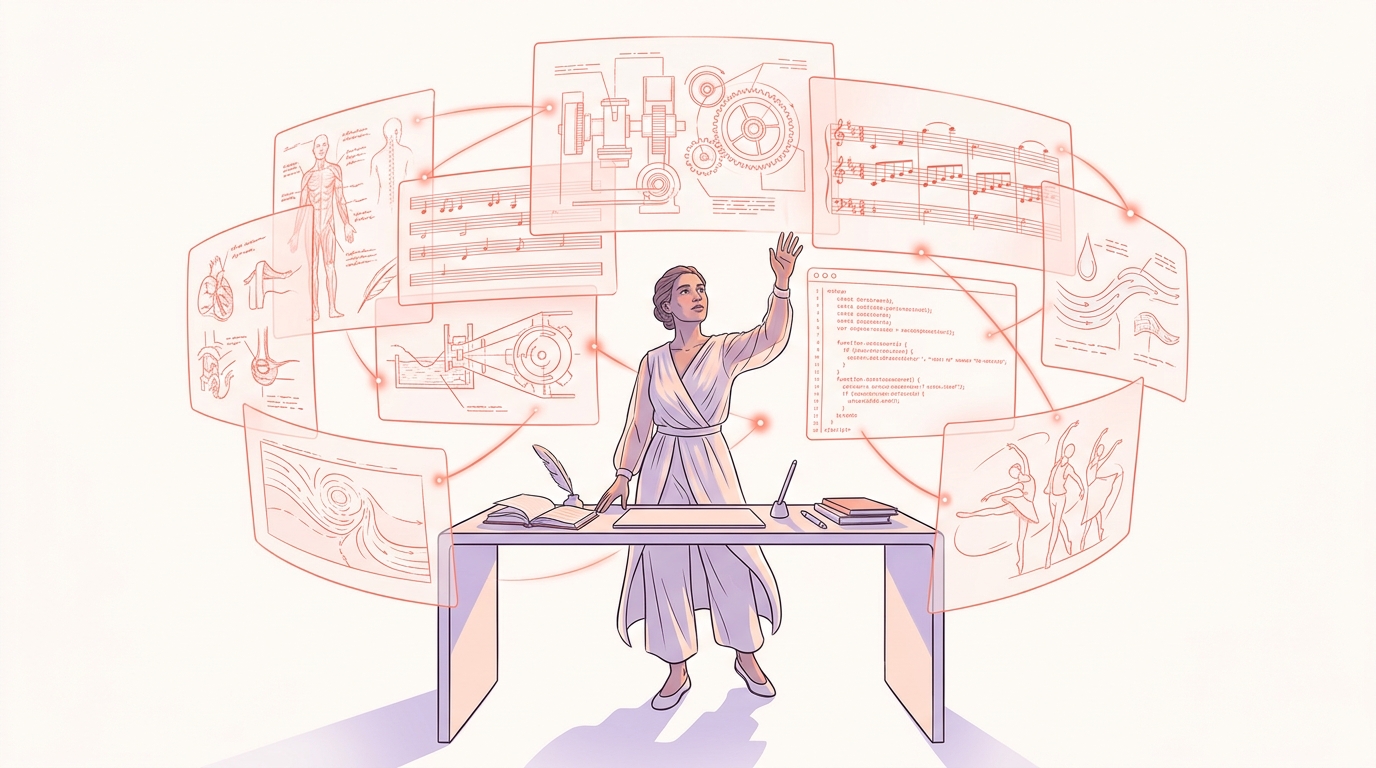
Lately I keep coming back to Leonardo da Vinci. Not as a poster, not as a Renaissance trivia answer — as a working hypothesis about where novel ideas actually come from. He painted. He dissected human bodies in candlelight. He designed war machines for warlords who didn't pay him on time. He sketched water — pages and pages of turbulence, vortices, the way a stream wraps around a rock. He drew flying machines centuries before anyone could build one. He didn't have a job. He had an obsession with everything that moved or held still.
You could say that about Tesla. About Newton. About Einstein, who played violin badly and wrote essays about pacifism and relativity in the same notebook. The pattern shows up too often to be a coincidence. The people who saw furthest were almost never specialists.
So here's what I've started to suspect: novel ideas don't come from going deeper into one structure. They come from carrying multiple structures inside you at once, deeply enough that they start to leak into each other.
I'll call it the quantum layer, because no other word fits. Not the physics — the metaphor. The place where things that look unrelated turn out to be the same shape underneath. Specialists see deep but narrow. They polish one tunnel until they can see grains of dust in the rock. Polymaths see less deep but make connections nobody else can. Da Vinci's anatomy lessons changed his paintings. His water studies changed his anatomy. His war machines came from watching how birds turned in the wind. The connections weren't decorations on top of his work. The connections were his work.
The modern version of this advice is "T-shaped" — be broadly competent, but pick one vertical to drill into. I think T-shaped is the compromise people make when they're too scared to say what they actually mean. What I see in the people I admire is closer to X-shaped. Or asterisk-shaped. Multiple deep verticals that happen to share a person.
That's not efficient. It's not what hiring managers want. It's not what advisors recommend. But it might be the actual shape of how breakthroughs happen.
I notice this in my own life, and I notice the cost too. I dance — six nights a week some weeks, salsa and timba, bodies and rhythm and reading another person without words. I write code. I run AI agents that handle parts of my business so I can spend more days outside. I host community events in Munich. I write essays like this one about philosophy and consciousness and what it means to be alive in a body that's also a machine running software. None of those things look related on a resume. All of them feed each other constantly.
When I built my first AI agent team last year, the architecture didn't come from reading more about agents. It came from how a Cuban dance circle works — one leader, many roles, everyone knows when to step in and when to step back, the energy is the protocol. When I think about community building, I think about how a salsa song is structured. When I think about my code, I think about how a body learns a new movement — slow, conscious, then suddenly automatic. The metaphors aren't literary flourish. They're the actual model I'm using to make decisions.
The cost is real. I don't have a clean career story. People meet me and ask "so what do you do?" and I watch their face flicker as I try to answer. I've been told I'm scattered. I've been told to focus. I've been told the reason I'm not richer is that I keep starting things. Maybe. Or maybe the reason I see the connections I see is the same reason it's harder to explain me on a business card.
There's another way to read the polymath. Not as a luxury — someone with enough privilege to dabble. Not as a flaw — someone who can't commit. But as a different mode of receiving. If novel ideas live at a layer where domains meet, then immersing in only one domain is like building a single-channel radio in a world where the signal is broadcast across many frequencies at once. You'll hear something. You won't hear everything.
I don't think everyone should be a polymath. Specialists matter. The world needs people who can spend forty years on one protein, one variable, one note. They go places nobody else can go.
But the people who change the shape of what's possible — Leonardo, Tesla, Newton, Einstein — almost always had more than one obsession running in parallel. They didn't choose. They couldn't choose. The thing that made them visionary was also what made them ungovernable.
I'm not comparing myself to Leonardo. I'm noticing the shape and asking whether the shape is actually the point. Whether "focus on one thing" is wisdom for most people but poison for some. Whether the polymath isn't a kind of person you decide to be, but a kind of person who can't successfully cut anything off without losing the channel that makes them useful.
I'm going to keep dancing. I'm going to keep writing code. I'm going to keep building communities and running agents and asking strangers strange questions in cafés. Not because I'm undisciplined. Because the disciplines feed each other, and shutting down one of them would be like covering one eye to see better.
Leonardo wasn't a painter who happened to do other things. He was a person whose painting came from doing other things. That's a different kind of life. And it might be a different kind of channel.
Join the discussion on Telegram!

Alösha
Building community platforms, teaching salsa, writing to find my people.