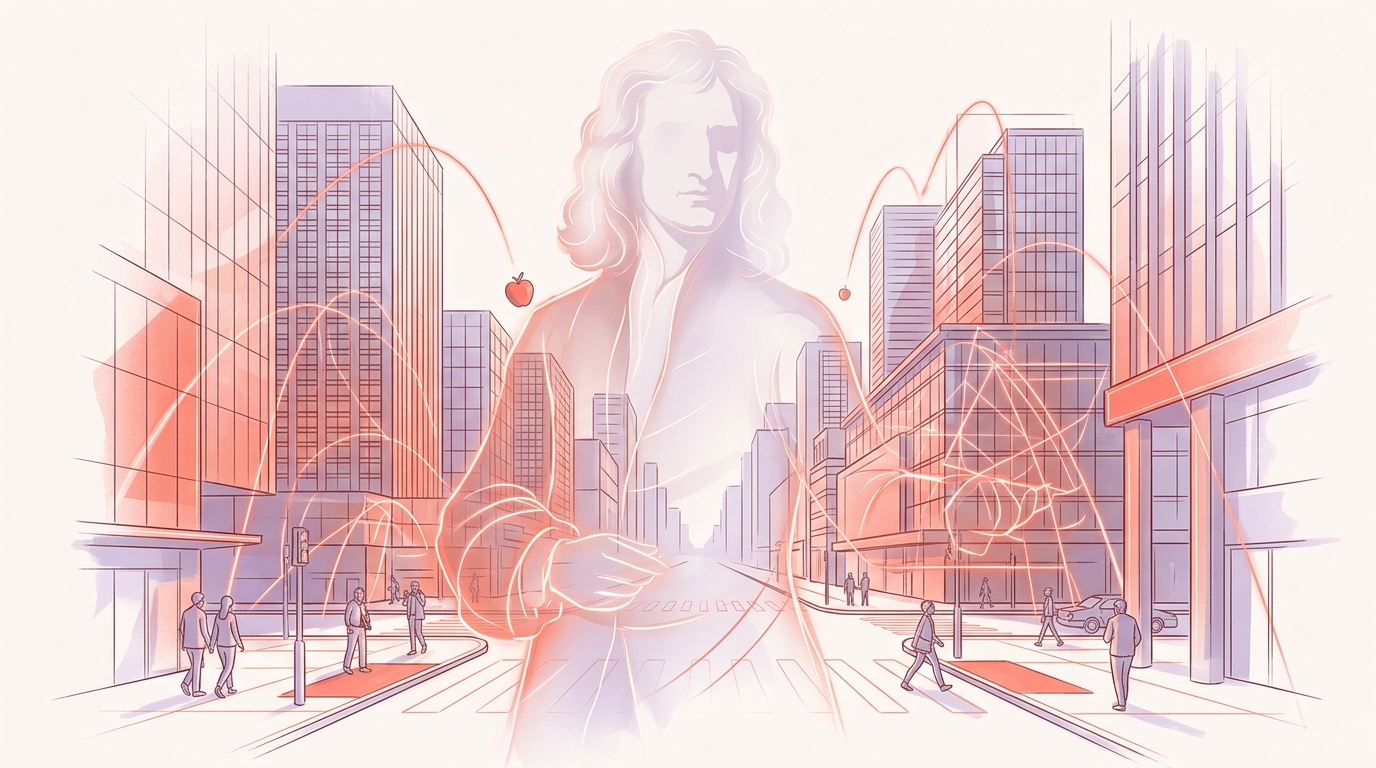
Reality Is an Egregore: Why We Still Live Inside Newton's Mind
Newton has been dead for almost three centuries. So why does his physics still feel like the floor under our feet?
I was watching a video the other night and a small thought slipped sideways into me: our reality is an egregore. Not a metaphor — a structural fact. The world we move through is held in shape by a thought-form so many people believe in that it has become the floor under our feet.
And the biggest, fattest egregore of them all is Isaac Newton.
What I mean by egregore
An egregore, in the simplest reading, is a living thing made of belief. A pattern of attention, kept alive by enough minds, that starts to behave like an organism. It eats belief, it shapes behavior, it persists across generations. Religions are egregores. National identities are egregores. Brands are tiny ones. Some are bright and warm. Some are dim and parasitic.
I don't think this is mystical. I think it's how groups of minds actually compose into something larger than themselves. The mistake is treating an egregore as imaginary because it isn't physical. It is doing real work in the world — it just lives one layer up.
Newton is dead. The egregore is not.
Isaac Newton died in 1727. Almost three hundred years ago. And yet I cannot walk across a room without paying tax to him.
Apple falls. Brakes work. Bridges hold. Planets orbit. We hear the words and feel calm — somebody figured this out, the universe has rules, the rules are knowable, the rules are predictable. That calmness is the egregore breathing.
Every physics class on the planet still opens with him. Every engineer still solves their first problem in his language. Even the people who later "move past" Newton — into Einstein, into quantum mechanics — built their next floor on top of his. The egregore is so deep that we mistake it for the room.
This is what makes Newton's egregore different from a religion you can leave. You can stop believing in a god. You cannot stop believing in gravity, because the moment you stop, you are simply someone who looks foolish to everybody else still inside the shared frame.
How the egregore runs your day
Watch yourself for an hour and you'll catch it.
You don't try to fly. Not even a small jump where you secretly wonder. You assume the floor will be there. You assume the future is the past plus some predictable arithmetic. You assume cause precedes effect. You assume objects exist independently of whether anyone is looking at them. You assume time flows forward at one second per second.
Each of those is a Newtonian assumption. Quantum mechanics already showed us several of them are not strictly true at the bottom layer. But the egregore doesn't run on what's strictly true. It runs on what we agree is true loudly enough.
The quantum world is where things actually live
Here's how I'm starting to think about it. The quantum world — the field of pure possibility — is where things really are. The material world is the precipitate. It's what falls out when the quantum world commits to a specific shape because enough attention has been pointed at it.
An egregore is a living organism inside that quantum field. It's a stable pattern of belief that keeps producing the same material outcomes over and over because we keep collapsing the wave the same way.
If that's even half right, then the rule for control is interesting. We can shape what we can imagine deeply. The deeper we know a structure on the inside, the more agency we have over it from the outside. Surface-level wishful thinking does nothing. Deep structural understanding moves things.
Newton built one of the deepest structural understandings any human has ever produced. Then everyone after him moved into his model and lived there. That's why his egregore is so heavy — not because it's wrong, but because it's deeply known by billions.
The cost of living inside someone else's model
Here's what bothers me. The more logical the model, the more it builds its own walls. A complete framework is a beautiful trap. You can move around inside it freely, which feels like freedom, but you cannot move outside it because you no longer have the words for what's outside.
Newton's egregore costs us flight, in the literal childhood sense and the metaphorical one. It costs us the ability to take seriously any phenomenon that doesn't fit — synchronicities, sudden knowing, healings that shouldn't have happened, the moment two people think the same sentence. The egregore quietly files those under "anecdote" and the day moves on.
It costs us the question of whether causality really runs only forward. It costs us the question of whether attention is passive or constitutive. It costs us, mostly, the willingness to even ask.
The Matrix line about the spoon is the same line. The spoon doesn't exist — but only if you have somehow stepped one layer outside the agreement that says it does. Most of us have not. I have not, on most days.
What I'm sitting with
I'm not arguing Newton was wrong. He wasn't. The egregore he built is one of the most useful structures the human mind has ever produced. Bridges hold because of it. I am writing this on a machine that exists because of it.
I'm noticing something different. That a model this powerful, kept alive by this many minds, this deeply, isn't just describing reality anymore. It is, partly, reality. And the part of reality it forecloses is invisible to anyone standing inside it.
So the question I keep turning over: which egregores am I currently feeding without noticing? Which ones are feeding me back? And is there a way to stand at the edge of a thought-form long enough to feel its shape, before deciding whether to keep believing in it?
I don't have the answer. I'm just starting to see the question.
Join the discussion on Telegram!

Alösha
Building community platforms, teaching salsa, writing to find my people.