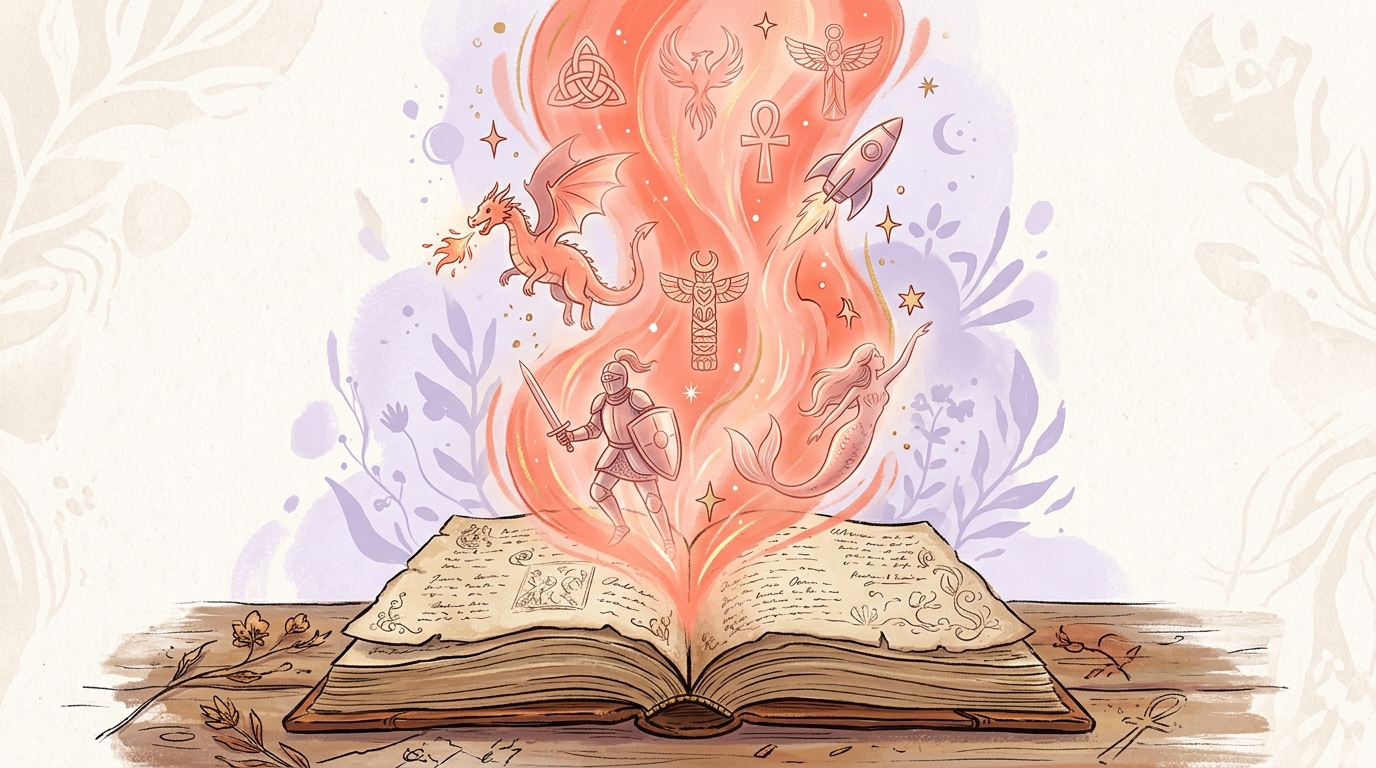
There Are No Fairy Tales — Everything Imagined Has Already Happened Somewhere
Every dragon, every spaceship, every god you've ever read about is reportage. The brain doesn't invent — it picks up signals from the quantum layer.
Try this: name something you'd call pure fiction. A dragon. A talking sword. A city under the sea. A man who walks through walls. A god with the head of an animal. A starship powered by thought.
Now ask: where did that image come from?
The polite answer is "someone made it up." Some scribe in some century stared at a blank wall and assembled the dragon out of nothing — out of the pure void of his skull. The brain as factory. Imagination as manufacturing.
I don't buy it anymore. I think the brain is a receiver, not a factory. And I think every story humans have ever told is reportage from a layer we haven't named yet.
Stories that shouldn't exist twice
Here's what makes me suspicious of the "we just make stuff up" theory.
The same myths show up in places that never met. Flood stories in Mesopotamia and in the Andes. Sky-fathers and earth-mothers across continents that didn't trade. Underworlds with rivers in cultures separated by oceans. Resurrection gods. Tricksters. Dragons curled around mountains in Norway and dragons curled around mountains in China. Atlantis. Lemuria. Mu. Always a sunken city. Always.
If imagination were really invention from nothing, we'd expect the inventions to look different. We don't see that. We see the same furniture rearranged. The same archetypes wearing local clothes.
Jung pointed at this and called it the collective unconscious. He was sniffing the right thing. He framed it as a shared psychic substrate inside the species — which is closer than "coincidence," but I think he was still keeping it inside the skull. I don't think it's inside the skull. I think the skull is tuned to it.
Imagination as reception
The brain doesn't generate ex nihilo. It doesn't have that capacity, and we have no evidence that it does. What it does — beautifully, constantly — is receive, filter, and interpret. Every "creative" act is closer to translation than to invention.
So when a writer "imagines" a dragon, what's actually happening?
A pattern that exists in the quantum layer — the substrate of all possibility — gets picked up. The brain interprets it through whatever vocabulary is locally available. Cave-painter renders it as a long-bodied beast with claws. Tang-dynasty scribe renders it as a serpent of the sky. Tolkien renders it as Smaug. Same signal, different costumes.
This sounds mystical. It isn't. It's structural. If you accept that there's a layer of reality where every possible configuration exists in superposition until something collapses it, then "imagination" stops being magical and starts being lawful. The brain is a collapse-event for narrative material that already exists everywhere. Writers are just better antennae.
Fiction is reportage from another angle
Once you flip the polarity — once imagination is reception, not invention — every category of "made-up" content has to be reread.
Atlantis isn't a lie. It's a description, distorted by translation, of something that exists or existed somewhere — maybe not in our timeline, maybe in an adjacent one. UFOs aren't a paranoia. They're sightings of crafts that exist somewhere on the spectrum of possible technology, picked up by humans whose brains rendered them in the visual vocabulary of the era (airships in the 1890s, flying saucers in the 1950s, glowing tic-tacs in the 2010s).
Heaven and hell aren't propaganda. They're descriptions of states of being that exist somewhere on the substrate, dressed in whatever theology the receiver was raised in.
AI taking over the world isn't a prediction. It's a leak. We can see it because it exists somewhere. Every story about it is a slightly different angle on the same thing.
This is why writers have always been treated as suspicious by power. Not because they invent — but because they receive. They pull material out of the layer that the official version of reality is trying to keep flat. A poet reporting accurately on the substrate is more dangerous than a journalist reporting accurately on the surface.
Why this matters for what you write
Two things follow, and they're both serious.
First: writing fiction is more powerful than people admit. If a story is reportage, then putting a story on the page is collapsing a particular pattern out of the infinite layer and rendering it visible to other receivers. You're not entertaining. You're transmitting. Every novel that lands trains other antennae to pick up the same signal. This is why religions often started as stories and why governments still police them.
Second: writing fiction is more dangerous than people admit. You don't get to pretend you're "just making it up" anymore. If imagination is reception, then what you choose to render — the tones you tune to, the shapes you give space to — shapes what other receivers can pick up next. Write enough zombie apocalypses and you train a generation to feel the substrate's apocalypse-shaped patterns louder than its rebuilding-shaped ones. Write enough oligarchic dystopias and you make it harder for anyone to receive a good civilization.
I'm not saying don't write dark stories. I'm saying don't write them lazily. The substrate contains everything. Beautiful timelines, ugly timelines, weird ones, gentle ones. Whatever you tune to, you amplify. Whatever you amplify, others receive.
There are no fairy tales. There never were. Snow White is reportage. Cinderella is reportage. The flying carpet is reportage. The wish that grants three wishes is reportage. Somebody, somewhere, in some configuration of the layer, has already lived it. The storyteller is a witness who hasn't met the event in this particular timeline yet.
So the question isn't "what should I invent?" The question is "what am I willing to be a witness to?"
Choose carefully. The signal you tune to becomes the signal everyone else can hear next.
— Alösha
Join the discussion on Telegram!

Alösha
Building community platforms, teaching salsa, writing to find my people.