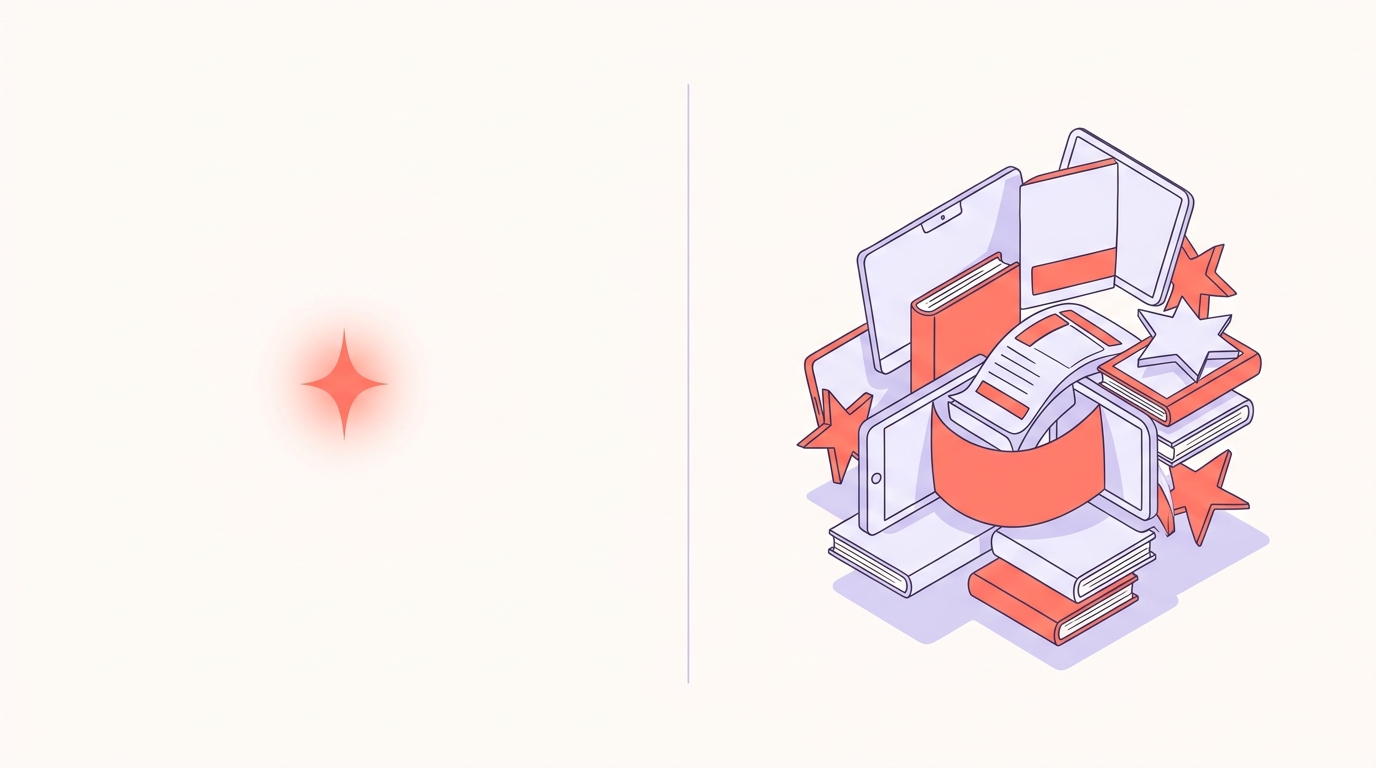
Novel Ideas vs. Remixes: Why Most Content Is Fusion, Not Creation
Most of what we call creativity is fusion — recombining existing pieces. A novel idea is something else entirely, and far rarer than the feed admits.
I think most of what gets called "creativity" is just two videos in a blender.
Someone watches a clip on Instagram. Then another. Then they cut them together, add a beat, push it out, and the algorithm rewards it. The result feels new. It looks new. It is, in some shallow sense, new — the exact combination didn't exist five minutes ago. But nothing in it came from outside the existing pile. It's a remix. A fusion. A reshuffling of cards that were already on the table.
That's not the same thing as a novel idea. And lately I've been spending a lot of time sitting with that gap.
Two different categories
A remix takes existing material and rearranges it. The inputs are visible. You can usually point at the sources — this beat, that meme, that interview, that thumbnail style. The work is in the recombination, and recombination can be skillful, even masterful. A great DJ is doing serious work. So is a great essayist who weaves five thinkers into one argument. I'm not running down fusion. Fusion has real value. It's how most of human culture moves forward — slowly, by mixing.
A novel idea is something else. It arrives. You can't fully trace its inputs because some of it didn't come from the inputs. It feels less like rearranging cards and more like a new card showing up on the table. Tesla describes alternating current arriving as a vision while he was walking in a park, reciting Goethe. Einstein chases a beam of light in his head for years before relativity falls into place. Da Vinci stares at a corpse, at a bird's wing, at water moving around a rock, and notices structure that nobody noticed before — and then keeps noticing, in notebook after notebook, for forty years.
I think of a novel idea as a fresh signal from the quantum world. You don't manufacture it. You make yourself the kind of antenna that can receive it.
What it costs to receive
If novel ideas were just "think harder, more often," the feed would be full of them. It isn't. So the cost has to be somewhere else.
A few things I keep coming back to.
Long staring at structure. Da Vinci didn't dissect one body. He dissected thirty. Tesla didn't tinker with motors for a weekend. He worked the geometry of rotating fields for years before AC clicked. Novel ideas seem to need an absurd amount of unrewarded looking — sustained attention to a system long after a normal person would say "got it" and move on.
Deep knowledge across domains. A remix happens inside one domain — dance videos remixed with dance videos. A novel idea seems to need at least two distant domains held in the same head. Da Vinci held painting and anatomy and hydraulics and military engineering at the same time. Einstein held physics and philosophy of time. The cross-pollination is where the unfamiliar shapes appear.
Willingness to look like a fool. Every novel idea, before it's accepted, sounds wrong. Tesla pitched AC against the most successful inventor of his era and was publicly humiliated for it. Einstein's first paper sat in obscurity. The novel idea, in the moment it arrives, has zero social proof. If you need the room to nod before you'll commit, you're going to filter out exactly the ideas worth having.
None of these are skills you can short-cut. They take years. They look, from the outside, like wasted time.
The mirror, then
Now turn the lens on what we're actually producing.
TikTok is, almost by design, a fusion engine. The platform rewards format adoption — see a working hook, copy the structure, swap the content. AI-generated content is even more explicitly a fusion engine: by definition, it interpolates between things that already exist. There are people doing genuinely original work on these platforms — but the median post is two videos in a blender, and the median AI output is the average of its training data, lightly stirred.
I'm not against any of it. I make plenty of remix content myself. The honest move is just to call it what it is. When I post a thread that's three frameworks I've read fused into a fourth, I'm doing fusion. When I shoot a dance video in a style I learned from someone else's dance video, I'm doing fusion. That's fine. It's useful. People will recognize it and use it.
But fusion is not origination. And conflating the two is what makes a generation of creators feel like they're "creating" full-time and yet quietly suspect that nothing they make would survive if all the source material were removed.
How do you tell?
Here's the test I use on myself, when I'm not being kind.
Ask: if you removed every piece of content you've consumed in the last six months — every video, every podcast, every book — would this idea still exist? If yes, it's probably novel. If no, it's a remix, and that's worth being honest about.
The second test: am I willing to sit with this question long enough to look stupid? Long enough that nobody is clapping yet? Long enough that even I'm not sure it's going anywhere? Tesla and da Vinci and Einstein lived inside that "nobody is clapping" zone for years. Most of us bail in a week.
I don't think everyone needs to be Tesla. Most days I'm fine being a remixer. The output of fusion is real and useful and pays bills.
I just want to know, on any given day, which one I'm doing.
Join the discussion on Telegram!

Alösha
Building community platforms, teaching salsa, writing to find my people.