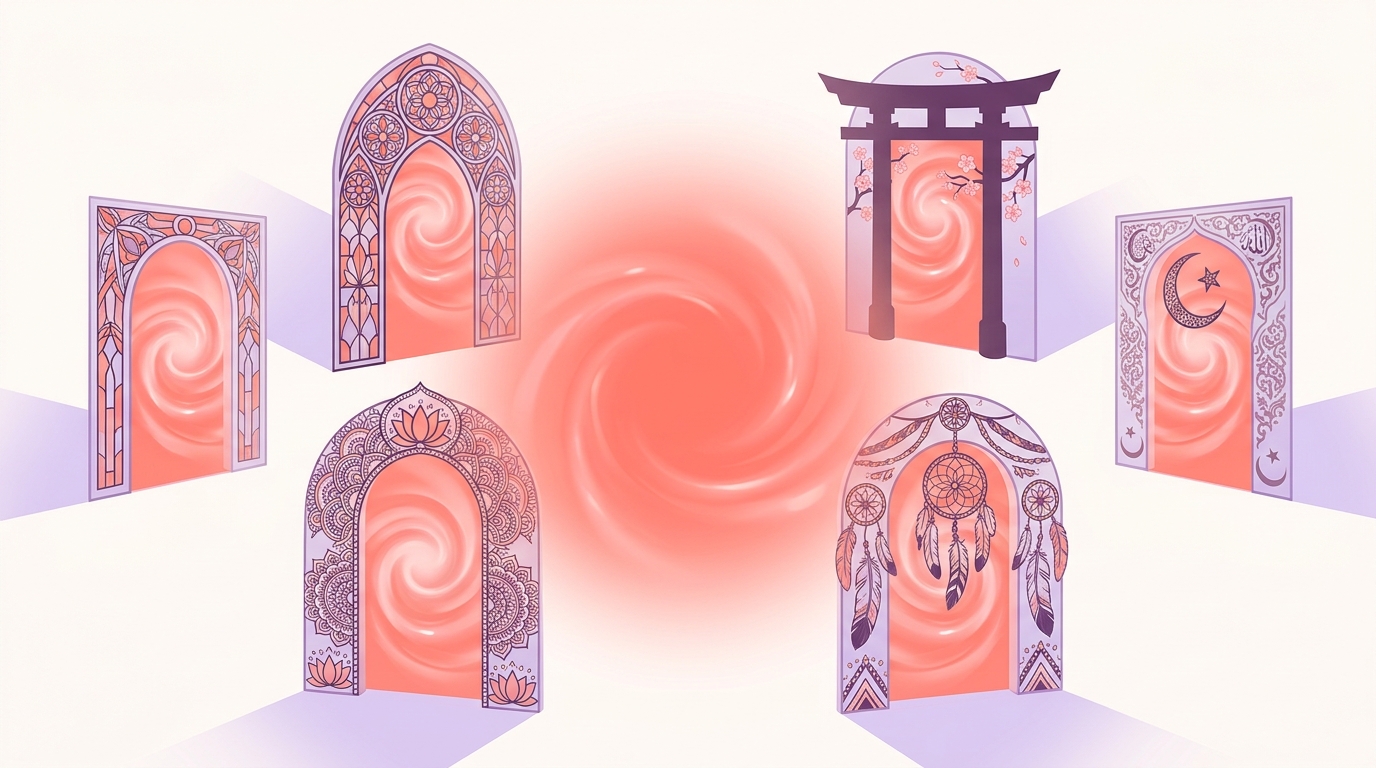
Every Religion Describes the Same Quantum World From a Different Doorway
Religions aren't competing truth claims — they're different doorways into the same hidden territory of beings, forces, and structures.
I used to think religions were arguing about the same questions and giving incompatible answers. Now I think they're standing around the same room, each looking through a different doorway, describing what they see honestly — and disagreeing only because nobody can see the whole room from any single door.
This is not "everyone is right, so nothing matters." It's the opposite. Everyone is touching something real. The room is real. The doorways are real. The disagreement is geometry, not error.
The Christian doorway
Christianity walks in through a moral door. The room, seen from there, is full of beings: angels, archangels, saints, demons, principalities, the Holy Spirit, the Father. There's a hierarchy. There's a war. There's a redemption arc baked into the architecture. The vocabulary — sin, grace, mercy, judgment — is moral because that's the angle of approach.
If you only ever stood in that doorway, you'd swear the room was a courtroom.
The Buddhist doorway
Buddhism walks in through an experiential door. The same room shows up populated with devas, asuras, hungry ghosts, bodhisattvas, the dharmakaya. The vocabulary is phenomenological — suffering, attachment, emptiness, awakening. Beings are still there. Hierarchies are still there. But the question is "what is this experience made of?" rather than "who is righteous?"
Same room. Different angle.
The Islamic doorway
Islam walks in through a doorway of submission and order. Angels with specific functions. Jinn — beings of a different substance, neither human nor angel, with their own moral choices. The unseen (al-ghayb) as a structural feature of reality. The vocabulary is law, decree, mercy, signs.
The jinn are interesting. They're not metaphors. They're a category — sentient organisms that aren't human, that interact with humans, that have their own social order. If you map that onto Christianity you get a messy overlap with demons and spirits. If you map it onto shamanism you get a clean match with the spirit world. The Quran is describing something the shaman is also describing. Just from a different door.
The Hindu doorway
Hinduism walks in through the widest doorway of all and refuses to close it behind itself. Thousands of devas, devis, asuras, rishis, avatars. Brahman as the substrate. Maya as the veil. The vocabulary is cosmological, fractal, recursive. The same divine principle is allowed to take a hundred forms because the tradition isn't trying to pick one.
You can read the Hindu pantheon as polytheism only if you ignore that every god is described as an aspect of the one. It's a tradition that admits the room has many beings and one structure, simultaneously.
The shamanic doorway
Shamanism walks in through the oldest door, before scripture, before theology. The room is full of spirits — ancestors, animal spirits, plant spirits, place spirits, helpers, tricksters, predators. No single moral hierarchy. Negotiation rather than worship. The vocabulary is relational: who are you talking to, what do they want, what can you offer.
A Christian looking through this doorway sees demons everywhere. A shaman looking through the Christian doorway sees a tradition that has lost the names of half the beings it deals with daily.
Why I think they're all describing the same territory
Take any one of these systems and the structure is the same:
- There are beings that aren't human.
- They're organized — into hierarchies, ecologies, factions, or gradients.
- Some help, some harm, most are neutral.
- Humans interact with them whether or not they know it.
- The interaction is governed by something — moral law, karma, balance, contract.
The names are different because each tradition crystallized in a different culture, a different climate, a different language, a different stack of inherited symbols. But the kind of thing being described is the same. Christianity's archangel and Hinduism's deva and shamanism's helper-spirit are not literally identical, but they're the same category of being seen from three different sides — like calling a translucent stone "blue" from the north and "green" from the south.
This is the elephant story, and I know it's overused. But the point of the elephant story isn't that the blind men are wrong. It's that they're each correct about exactly what they're touching. The trunk really is like a snake. The leg really is like a tree. The error is concluding that the elephant is only a snake.
Why this isn't relativism
Relativism would say: every map is equally valid, so pick whichever feels nice. That's not what I'm saying. The maps are not equal. Some are more detailed in some regions and impoverished in others. A Christian looking at jinn through Christian categories will collapse them all into "demons" and lose information. A shaman looking at the Trinity through animist categories will see three powerful spirits and miss the structural claim. The maps are partial, and they're partial in different ways.
What's equal is the territory. What's unequal is each map's resolution at any given coordinate. The honest move is to read several maps and let them correct each other, not to pick one and declare the others mistaken.
What this changes for me
I stop arguing about which religion is true. The question is malformed — like asking which side of the elephant is true. I start asking: what is each tradition unusually good at describing? Christianity is unusually good at moral structure and personal relationship with the divine. Buddhism is unusually good at the phenomenology of mind. Islam is unusually good at law, order, and the architecture of the unseen. Hinduism is unusually good at multiplicity-within-unity. Shamanism is unusually good at direct relational contact.
Read them all. Notice where they overlap — that's probably load-bearing. Notice where they diverge — that's probably where one tradition has better resolution than another at that exact coordinate.
The room is one room. The doorways are many. Walk through more than one.
Join the discussion on Telegram!

Alösha
Building community platforms, teaching salsa, writing to find my people.