The Spoon Doesn't Exist: How Logic Builds the Cage You Can't Escape
The smarter you are, the tighter your prison. How logical frameworks become invisible cages, and why your PhD might be the bars.
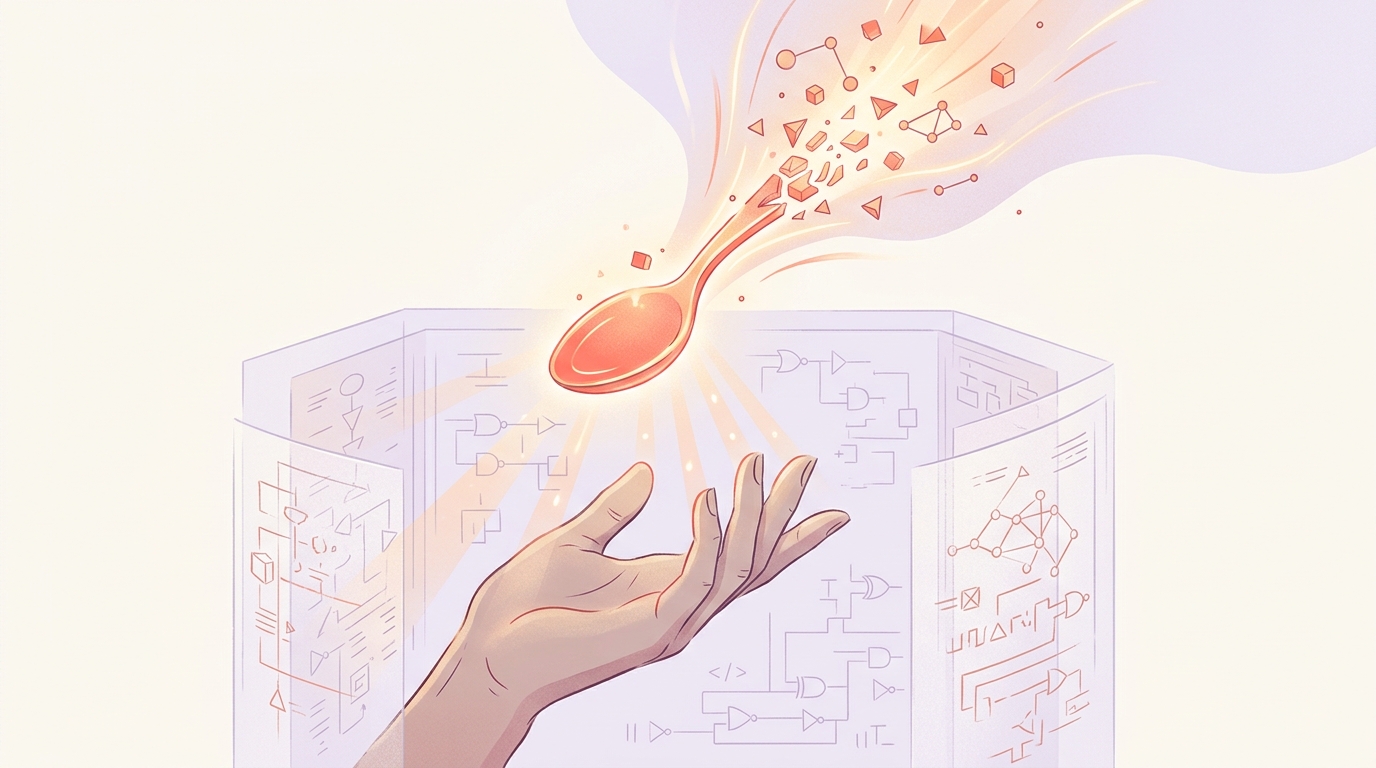
There's a scene in The Matrix that I keep coming back to. Neo is waiting in the Oracle's apartment, and a small boy in monk robes is bending a spoon with his mind. Neo tries to do the same. The boy looks at him and says: don't try to bend the spoon. That's impossible. Instead, only try to realize the truth — there is no spoon.
Most people watch that scene and file it under "movie magic." I watched it again last week, and I think it's the most accurate piece of philosophy in any blockbuster.
Because here's what I've started to notice in my own life, and in the lives of every smart person around me: the more logic you stack on top of reality, the more reality bends to fit your logic, until eventually you mistake the logic for reality itself. And then you can't bend the spoon. Not because the spoon is real — but because your model of the spoon has become so thick that you can no longer see through it.
The trap is built from your own intelligence
If you base everything on Newton's physics, you've already limited yourself. Newton is a useful approximation for a narrow band of conditions. It's not the universe. The universe has quantum behavior, relativistic behavior, a hundred regimes Newton doesn't reach. But once Newton is the floor of your reasoning, anything that doesn't fit becomes "impossible" — meaning, impossible inside the model you accepted.
That's the cage. And it's not made of iron. It's made of your own carefully accumulated intelligence.
This is why I find PhDs fascinating, and a little tragic. A PhD is a four-to-seven-year exercise in building one extremely refined logical framework and getting paid to never leave it. The output is real expertise. The hidden cost is that the framework becomes invisible — it stops feeling like a lens and starts feeling like the world. A dropout might be wrong about a hundred things. A PhD is wrong about one thing, deeply, with a forty-page bibliography defending the wrongness.
Smart people build smarter cages.
I've watched myself do this
I've shipped enough code to know the engineering version of the spoon. You absorb a stack — React, Postgres, REST, microservices, whatever — and within a year, every problem you see arrives pre-shaped to fit that stack. A new feature comes in, and your brain doesn't ask what does this need to be? It asks which of my existing components can I press into service? The architecture you already know becomes the universe of possible architectures. Things that would be trivial in a different paradigm become "hard" — not because they are, but because the path to them runs through territory your logic has already labeled "off-map."
I've watched myself reject ideas not because they were bad, but because they didn't compile inside the framework I was running.
The same trap shows up in startups. Someone reads enough Y Combinator essays and now every new project must have a wedge, a moat, a CAC-LTV ratio, a Series A narrative. Those frameworks aren't wrong. They're just one shape of business, sold so confidently that founders stop noticing the outlines of every other shape. People with deep startup experience can become worse at seeing weird, slow, profitable, non-scalable opportunities — because the slow non-scalable shape doesn't pattern-match to anything in their model.
And in life decisions: I have friends with multiple master's degrees who can articulate, in beautiful detail, exactly why they cannot quit the job they hate. The articulation is the prison. The argument is airtight. That's how you know it's a cage — a cage is just a logical structure with no exit door inside its own axioms.
What "the spoon doesn't exist" actually means
The line isn't a trick. It isn't "spoons are illusions, eat with your hands." It's a precise statement: the spoon-shape is a layer your mind added on top of something more open. Bending the spoon is impossible only inside the layer that says spoons are rigid metal objects with fixed properties. Step out of the layer, and the question of bending dissolves.
I think every limiting belief I've ever held has had this structure. Not "I can't do X." More like "I have built such a thorough logical case for why X works the way it does, that the version of X where it works differently isn't even a thought I can finish."
The spoon, for me, has been:
- Software has to be built by employees. (Then I started running agents.)
- Audiences are built by being consistent on one platform. (Then I watched people grow on no platform at all.)
- Income has to come from a job or a company you own. (Then crypto, then AI, then a dozen other shapes I had no template for.)
- Relationships work this way and not that way. (This one I'm still working on.)
Every time I've stepped out of one of these, the move didn't feel like learning something new. It felt like taking off a pair of glasses I didn't know I was wearing.
How to notice your own spoons
I don't think you can think your way out of this. The cage is made of thinking. But I've found a few things that help:
- Pay attention to the word "impossible." When I catch myself using it, I now ask: impossible everywhere, or impossible inside the framework I accepted at twenty-three? Almost always, the second.
- Hang out with people whose framework is incompatible with yours. Not "different" — incompatible. A musician, a farmer, a Buddhist monk, an eight-year-old. They will say things that don't compile in your head. The crash is the gift. That's the spoon flickering.
- Notice when the argument is too clean. Reality is never as tidy as the case you've built for why something can't change. If your reasoning has no loose ends, you're probably reasoning inside the cage, not about it.
- Try the thing that "obviously won't work." Not as a leap of faith — as an experiment. The cost of testing a single belief is almost always lower than the cost of carrying it for the next decade.
- Watch the children. Kids haven't built the cage yet. They bend spoons all day. We call it imagination, then we train it out of them, then we pay therapists to give it back.
The boy in the Matrix isn't doing magic. He's doing what we all could do before we got educated out of it. He just never accepted the premise.
Join the discussion on Telegram!

Alösha
Building community platforms, teaching salsa, writing to find my people.