What Tesla, Da Vinci, and Newton Actually Did (And Why It Wasn't 'Work')
The myth says geniuses out-grinded everyone. The record says they sat still long enough for the next layer of the universe to come find them.
Tesla saw the AC motor whole, in a park in Budapest, while reciting Goethe to a friend. He did not derive it. He watched it appear in front of him with such clarity that he could pace around it, mentally, and inspect the bearings. He wrote it down later because someone had to.
This is the part of the story we keep editing out.
We took the lives of the people who actually changed the trajectory of the species — Tesla, Leonardo, Newton, Einstein — and we cropped them down into a productivity meme. Ten thousand hours. Grit. Compound interest of effort. The implication being: if you just grind harder, longer, with better tooling, you too will arrive at general relativity.
I don't think that's what happened to any of them.
I think what they actually did is much harder than grinding, and much less marketable. They got quiet enough to receive.
The myth doesn't fit the evidence
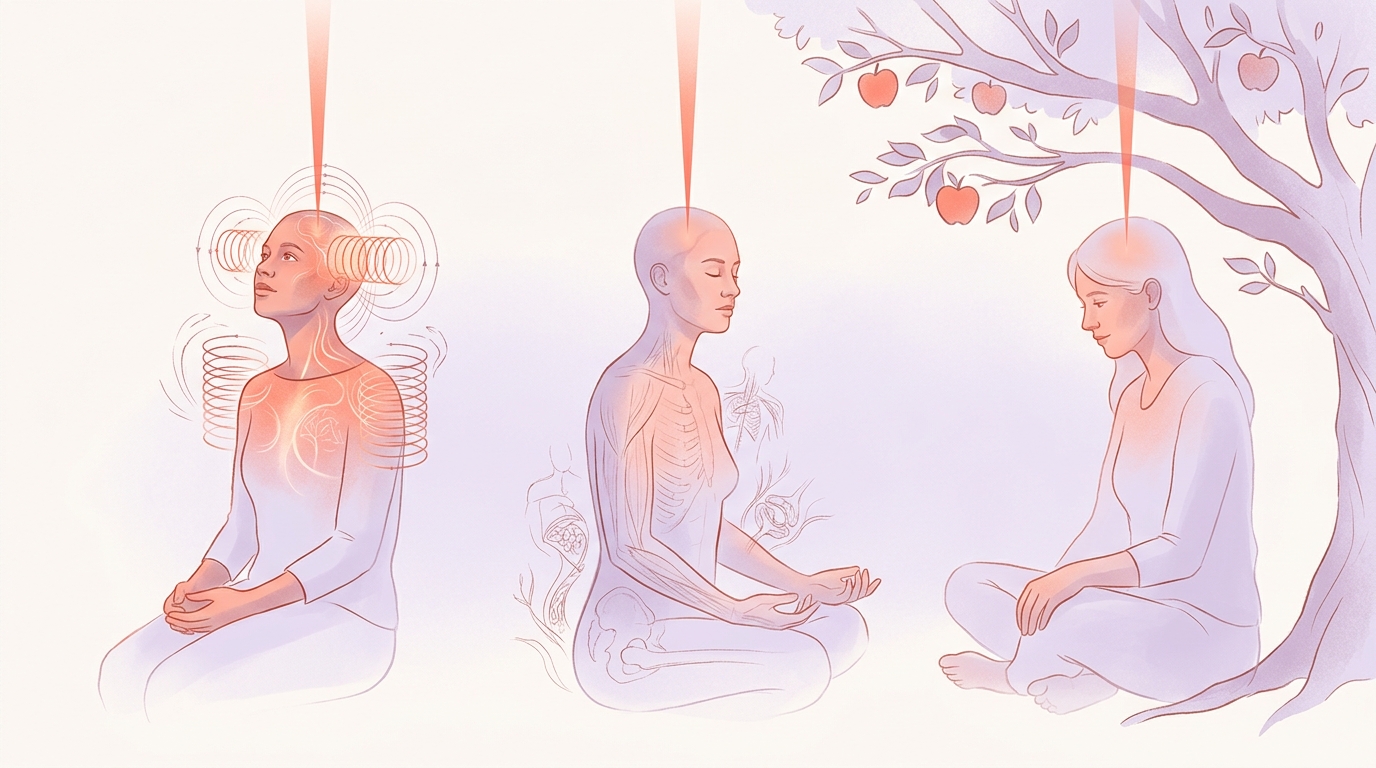
Newton said gravity came to him when he was sitting. Sitting. Not in a lab. Not in a sprint. Under a tree, in a garden, in plague-time isolation, watching an apple fall. The story is so worn out it has become decorative, but read it literally for a second: a man sat outside long enough that an apple's behaviour became suggestive. Most of us cannot sit outside for fifteen minutes without checking our phone. He sat there for months.
Da Vinci's notebooks read, when you actually open them, like nothing a productive person would produce. They are not deliverables. They are a transcript. He sketches a heart valve, then a war machine, then a cat mid-pounce, then water, then water again, then water for three more pages. He's not executing on a roadmap. He's noticing what's coming through and writing it down before it leaves.
Einstein's most famous arguments are imaginary train rides. He did not run an experiment. He sat with the question of light and time and pictured himself riding alongside a beam, and noticed something was off about how the universe should look from there. We call them thought experiments. He called them seeing.
Tesla, again: "The idea came like a flash of lightning, and in an instant the truth was revealed." The motor that powers half the planet today arrived as a vision, fully assembled, while he was watching the sunset and reciting poetry.
If we're honest, none of these people sound like the productivity protagonist we sell. They sound like antennas.
The work was the becoming-still
Here is what I think is actually going on, and I'll say it plainly so you can disagree.
Novel ideas don't come out of effort. They come out of the same place dreams come from, the same place a melody arrives from when a musician swears they didn't write it, the same place a name floats up the moment you stop trying to remember it. Call it the unconscious, call it the field, call it the quantum world. The label doesn't matter. What matters is that the bandwidth is narrow, and a panicking human brain is too loud to hear it.
So the genius's actual job is not producing. It's tuning. Building a clean enough channel that when something true wants to land, there's a place for it to land. That's why Tesla and Leonardo and Newton spent so much of their time in stillness, in walks, in long single-pointed attention on a single shape. They were doing the one thing that lets the next layer reveal itself: holding a problem long enough, gently enough, that it stops hiding.
This is much harder than grinding. Grinding is loud — you can do it on coffee, on adrenaline, on fear of being seen as lazy. The quiet version has none of those rewards. From the outside it looks like nothing. From the inside it often feels like nothing too, until it doesn't, and then everything is different.
In 2026, the channel is jammed
Now imagine a Tesla in 2026.
He sits down to think and a notification arrives. He pushes it away, sits again, and a different one arrives. He goes outside and his pocket buzzes. He picks up the phone "for one second" and forty minutes later he has consumed twenty other people's incomplete thoughts and produced none of his own. He opens an AI chat to outsource the thinking and gets a confident answer, instantly, before the question has even finished forming inside him. The pause that would have let his own answer arrive has been pre-filled.
We did not lose the right to think. We lost the silence that makes thinking possible.
AI isn't the villain here. AI is just the most recent and loudest in a long line of channel-jammers. Television was one. Newspapers were one. The cost is the same: the inner room never gets quiet, so nothing wants to land there.
If you want what Tesla had, the move in 2026 is unfashionable and obvious. Walk without your phone. Sit with a problem for an hour without searching for the answer. Let yourself be bored — bored is the doorway, not the failure state. Stare at water like Leonardo did. Do the thing that looks, from a calendar's point of view, like nothing.
You will feel like you're falling behind. You aren't. You're tuning.
What I'm trying
I'll be honest, because I don't want this to sound like I figured it out.
Most of my days, I'm jammed. Too many tabs, too many notifications, I confuse activity with progress, I dispatch tasks to agents and then immediately fill the recovered time with more tasks. By the standard of this post, I am a terrible antenna.
What I have started doing — badly, and inconsistently — is leaving the phone on the kitchen counter and walking. Not to "think about" something. Just to walk and let what's already inside me surface. The first ten minutes are noise: lists, anxieties, drafts of replies. The second ten minutes are quieter. Sometimes, in the third ten minutes, something arrives — a connection between two projects I hadn't seen, a sentence for something I'm writing, a calm that wasn't there before.
That's the whole practice. Embarrassingly simple. Almost impossible to maintain.
But I'm increasingly convinced this — and not the grinding — is the actual move. Tesla got the motor in a park. Newton got gravity in a garden. Leonardo got the human body in a notebook he refused to publish. They all did the same thing. They were available when something true came looking for them.
The rest of us are usually on our phones.
Join the discussion on Telegram!

Alösha
Building community platforms, teaching salsa, writing to find my people.