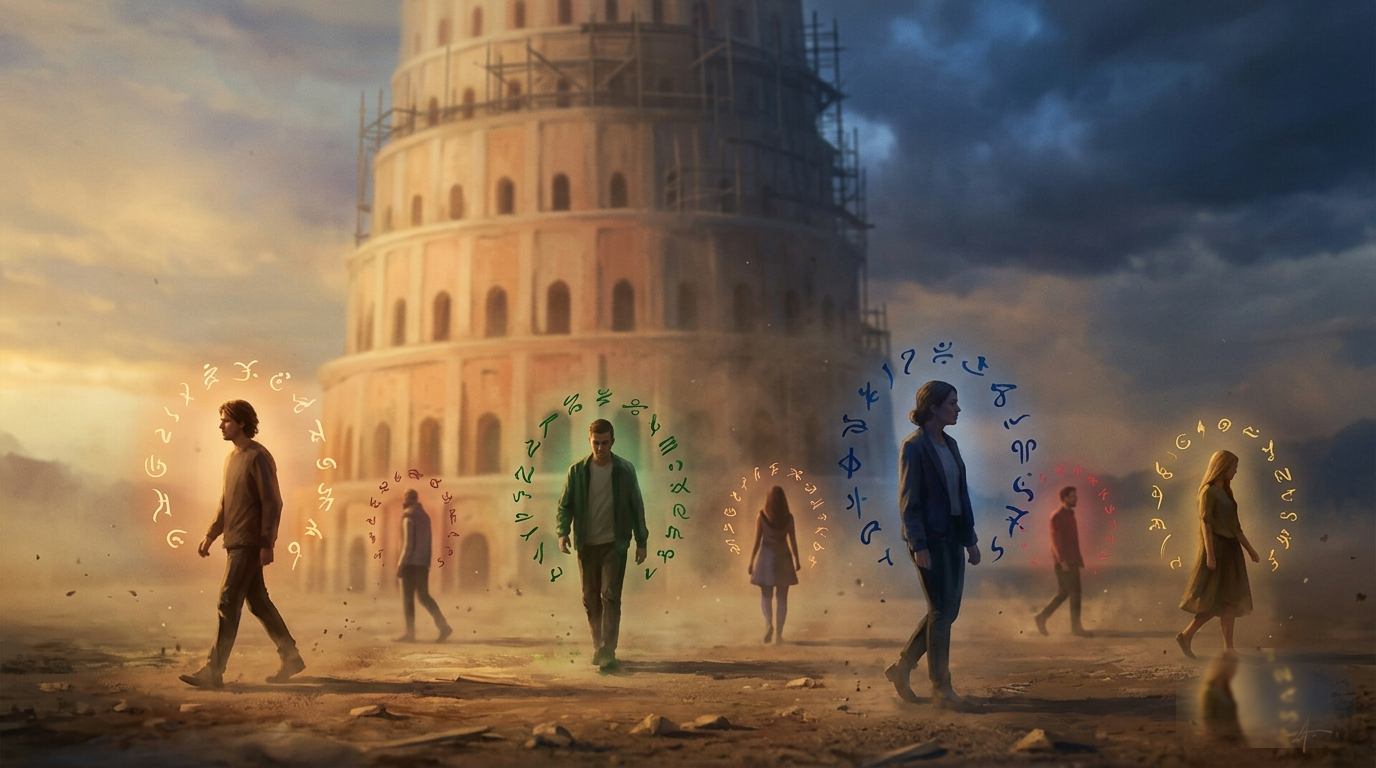
Fragmentation Is the Operating System of Control
Every control system in history runs the same algorithm: split what was whole, sell people the parts, and call it identity. Babel was a confession. And the pattern doesn't need a conspirator — which is worse, not better.
Babel is not a story about a punishing God. Babel is a confession.
The deity in Genesis 11 looks at humanity speaking one language, working on one project, and says — out loud — "nothing they propose to do will now be impossible for them." Then he scrambles their tongues so they cannot understand each other, and the project collapses.
Read it again. That is not a moral tale. That is whoever wrote it telling you, three thousand years ago, exactly how power works: people who can talk to each other can do anything, so the first move of every control system in history is to make sure they cannot.
I have been pulling on this thread for a while and I cannot find a bottom to it.
The same algorithm, different domains
Once you see the pattern in language, you start seeing it everywhere. Every functional control system I can name runs the same algorithm: take something that wants to be whole, split it into pieces, and sell people the pieces back as identity.
Split a continent into 500 languages, freeze them administratively into "tribes," then govern by playing them against each other. That is what the British did in Nigeria. Lord Lugard wrote a book about it in 1922 called The Dual Mandate. He is not hiding.
Split the human mind into "rational" and "emotional," call one IQ and the other EQ, build an entire educational system that sorts children by which they have more of, then put the IQ people in offices and the EQ people in service jobs and tell both that this is meritocracy. John Taylor Gatto — New York State Teacher of the Year, twice — wrote a book called Dumbing Us Down about exactly this. The Prussian model that American compulsory schooling is descended from was designed, openly, to produce obedient soldiers and obedient workers. There is no smoking gun because the gun was the curriculum and it has always been smoking.
Split human relationships into transactions, call the medium of those transactions money, then make people so afraid of losing money that they will accept any working condition to keep getting it. David Graeber spent five years writing Debt: The First 5,000 Years and showed something quietly devastating. The shift from informal "I owe you" economies — where everyone owes everyone something and the network holds — to mathematically precise, state-enforced debt requires constant violence. Police, prisons, armies. Debt without violence does not exist as a system. And he shows the language of debt and the language of sin share a root. Redemption is literally a debt word. Bought-back. Paid-off.
Split human action into "good" and "evil," where "good" is whatever reinforces the in-group and "evil" is whatever threatens it, then run every conflict in history through that lens and call yourself the good guys. René Girard built his entire anthropology on this — the scapegoat mechanism. The group about to come apart from internal rivalry needs an outsider to blame, and the outsider's death produces relief, which gets remembered as the sacred. Every founding myth has a body at the bottom of it.
Split knowledge into "for everyone" and "for initiates," put the initiates in robes, charge admission to find out what the robes mean, and pretend this is what wisdom requires. Elaine Pagels won the Pulitzer for showing that the early Gnostic Christians were suppressed not because they were heretics but because they taught direct knowing, and direct knowing makes bishops unnecessary. The institutional church we inherited is what happened to the people who won that argument.
Split a person from their own depth — keep them in what Gurdjieff called "waking sleep," reactive, mechanical, identified with whatever the last advertisement said — and you have a population that will hand over its decisions to anyone confident enough to take them.
I could keep going. There is a version of this paragraph for every domain you care about.
The move that took me a while to make
For a long time I thought: okay, so they are doing this on purpose.
This is where most people who notice the pattern lose the plot. They draw a circle on the map and write THEY inside it and start hunting for who THEY is. The Rothschilds. The Bilderbergs. The thirteen bloodlines. The reptiles, if you go all the way down that hole.
It is comforting to have a THEY. It puts a face on the machine. And it is also wrong, and it is the wrongness that gets the whole observation dismissed.
Here is what took me a long time to see, and what makes the observation actually load-bearing instead of just paranoid.
The pattern does not need a conspirator. The pattern is what an unsupervised system optimises for.
Michel Foucault spent his life on this. Pierre Bourdieu spent his life on this. Antonio Gramsci spent his prison sentence on this. Their joint finding, in the most compressed possible form: the institutions that sort and split us reproduce themselves automatically, without anyone deciding to enforce the sorting. A teacher who has internalised "the gifted kids" and "the regular kids" does not need a memo from headquarters. A bank that has internalised "creditworthy" and "uncreditworthy" does not need a phone call from a cabal. A news desk that runs on advertising revenue does not need a directive about which stories to cover. The filters are inside the people running the institutions. Most of them are good people. The machine still runs.
This is worse than a conspiracy, not better.
A conspiracy you could expose. A conspiracy you could overthrow. You could leak the documents and arrest the cabal and rebuild on better foundations. The fact that no leak has ever worked, that no arrest has ever fixed anything, that every revolution becomes the new regime within ten years — that should be a clue. There is no document because the document is the operating system, and the operating system is in everyone's head, including yours and mine.
That is the version of the thesis I believe. Not "they are doing it to us." More like: this is the shape any sufficiently large unsupervised system collapses into when its components are afraid.
Fear is the load-bearing emotion. That is the only thing the seven splits have in common: they all run on fear and they all produce more of it. Fear of being misunderstood. Fear of being stupid. Fear of being broke. Fear of being evil, or of looking like it. Fear of being unworthy of the secret. Fear of being the only one who can see. Fear of being awake at all — waking sleep is, among other things, anaesthetic.
Erich Fromm wrote a book in 1941 called Escape from Freedom. His thesis was that the ego that fears its own freedom will reach for any authority — fascist, religious, commercial — that will take the freedom back off its hands. Eighty-five years later this looks like the most accurate description of the 21st century anyone has ever written.
What to do, given that this is the situation
If you accept the diagnosis, the prescription has a shape. It is unromantic. It does not involve storming anything.
Integration is the practice. Wherever you find a split that has been sold to you as nature, undo it personally. Then help one other person undo it. Then maybe build a small thing — a community, a project, a room — where the unsplit version of that domain is the default.
That is what every project I work on is, in some version. WeDance is the integrated version of "dance scene" — the split between the salseros and the bachateros and the kizombatas and the swing kids dissolves the second they are in a room where the host does not enforce it. Agora is the integrated version of "governance" — the split between technocratic optimisation and grassroots consent collapses when you put the three layers in the right order. The 15x4 Munich talks are the integrated version of "education" — when an astrophysicist and a hairdresser and a meditation teacher each get fifteen minutes on the same night, the IQ/EQ caste line just stops being visible.
These projects are not commercially optimal. They are the opposite of commercially optimal. The market rewards the split, because the split is what creates the addressable segment. The integrated thing has no segment. You have to build the audience for it from zero, one repeated sentence at a time.
But the integrated thing has one property the split thing can never have: the people who find it stay. The exit cost of leaving an integrated community is the loss of integration itself, and nobody who has tasted that wants to go back to being addressed as a segment.
That is the bet. That integration scales slowly and then suddenly. That the people who built fragmented empires are the last generation that will be able to do it. That my generation, and the one coming after, are going to spend our working lives building the small unsplit rooms — in language, in education, in money, in morality, in governance, in consciousness — and that in fifty years the unsplit rooms will be where everyone lives, and the splits will look the way slavery looks to us now: obvious in retrospect, invisible at the time, defended at the time by people who could not imagine the alternative.
The Babel writer left us the clue. The deity in that story is not God. The deity in that story is fear of what people can do when they understand each other.
Stop being afraid and start understanding each other. The whole rest of it follows.
Join the discussion on Telegram!

Alösha
Building community platforms, teaching salsa, writing to find my people.