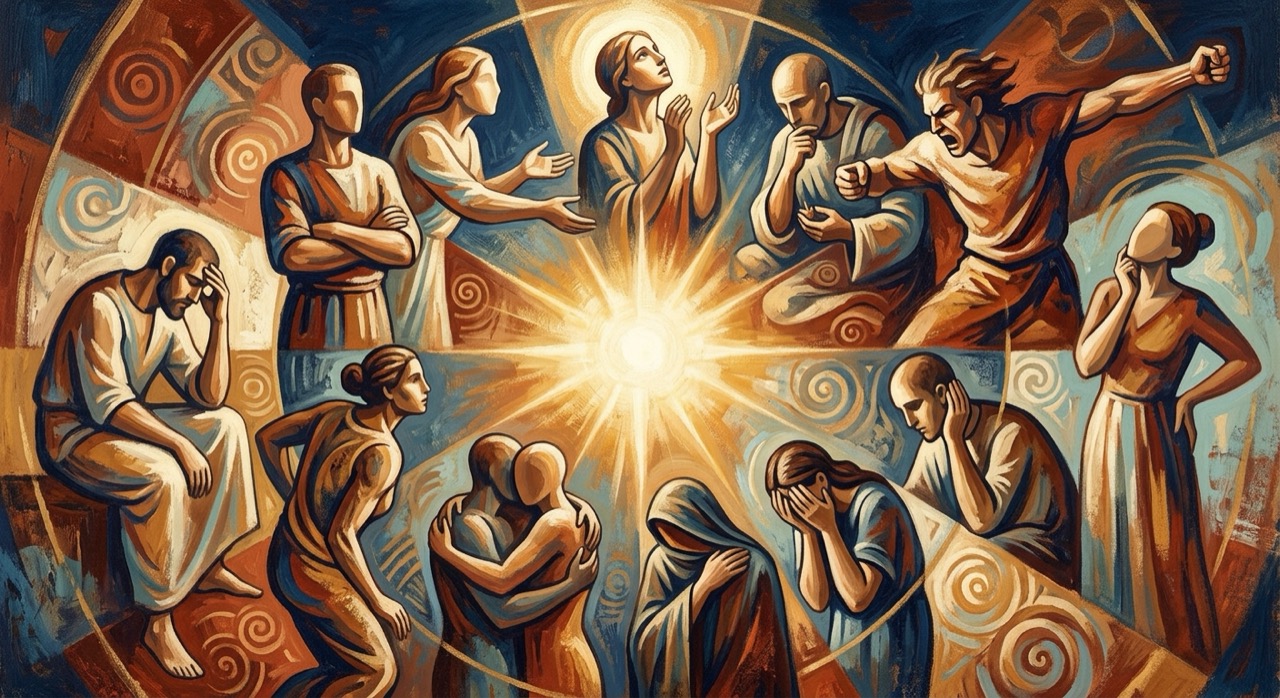
Twelve Apostles, Twelve Emotions, Twelve Ways of Thinking
A pre-cognitive-science cognitive map, and what's actually novel about adding Plutchik and Vygotsky to it.
I started with a small question and ended up on a strange road.
Someone asked me to name the main types of thinking. I gave the standard taxonomies — Kahneman's System 1 and System 2, de Bono's six hats, MBTI, mental models, CBT distortions. Then they said: "What about образное мышление, визуальное?" The Soviet developmental tradition — Vygotsky, Rubinstein, Leontiev — which classifies cognition into sensorimotor (наглядно-действенное), imagistic (наглядно-образное), and verbal-logical (словесно-логическое). I had missed an entire tradition.
Then the question shifted: map the thinking types to the twelve apostles. Then map emotions. Then check whether anyone had thought of this before.
The exercise turned out to be more interesting than I expected.
Why twelve
The number isn't accidental. Twelve recurs across symbolic systems — twelve tribes of Israel, twelve signs of the zodiac, twelve hours, twelve months, twelve knights of the Round Table, twelve apostles. The popular "12 Jungian archetypes" you find in marketing books? Jung never wrote them. The list was constructed in the 20th century, and there's a credible argument that the twelvefold shape was borrowed from the apostle and zodiac traditions because twelve is the culturally legible "complete set" number in the West.
If that's right, modern personality typologies inherit twelvefold-ness from the apostle tradition, not the other way around. The apostles aren't being mapped to cognitive psychology. Cognitive psychology has been quietly mapping itself onto the apostles for a hundred years.
The thinking-types mapping
Each apostle gets a textual handle from the Gospels — Peter is impulsive, Thomas demands evidence, Matthew structures and counts, Judas calculates. From those handles, a cognitive mode falls out almost on its own.
| Apostle | Thinking mode |
|---|---|
| Peter | Sensorimotor / System 1 — acts first, reflects later |
| Andrew | Convergent — the connector, funnels people toward a center |
| James (Zebedee) | Reactive judgment — "son of thunder," wants fire from heaven |
| John | Imagistic / intuitive — Revelation is pure visual cognition |
| Philip | Concrete operational — "two hundred denarii would not buy enough bread" |
| Bartholomew | Critical / skeptical — "can anything good come from Nazareth?" |
| Matthew | Sequential / analytical — tax collector, most structured Gospel |
| Thomas | Empirical / System 2 — "unless I see the marks..." |
| James (Alphaeus) | Tacit / implicit — the one we know nothing about |
| Thaddaeus | Reflective / metacognitive — asks how revelation works |
| Simon the Zealot | Lateral / system-breaking — imagines a different political order |
| Judas | Calculative / transactional — "what will you give me?" |
Some mappings are over-determined: John as imagistic-intuitive (Revelation is pure visual cognition), Thomas as empirical (the scientific method in one sentence), Matthew as sequential-analytical (the most structurally organized Gospel). Others are forced — James the Less has almost no textual material, so he becomes the "tacit knowing" placeholder by default. More on him later.
The emotion mapping
Plutchik's wheel has the cleanest 12-slot structure — eight primary emotions on four opposing axes, plus four secondary dyads formed from adjacent pairs.
| Emotion | Apostle | Why |
|---|---|---|
| Joy | Matthew | The feast he throws after his calling |
| Sadness | James (Alphaeus) | The quiet one. Sadness as silence. |
| Fear | Thomas | Doubt as fear of being wrong |
| Anger | James (Zebedee) | Son of thunder |
| Disgust | Simon (Zealot) | Moral rejection of the Roman order |
| Surprise | Bartholomew | The fig-tree moment |
| Trust | Andrew | The first-called who brings others |
| Anticipation | Philip | Always calculating what's coming |
| Love (Joy+Trust) | John | The beloved disciple |
| Awe (Fear+Surprise) | Thaddaeus | The metacognitive question |
| Remorse (Sadness+Disgust) | Peter | Denial → "wept bitterly" |
| Contempt (Disgust+Anger) | Judas | "What will you give me?" |
The most striking result: Peter and Judas land on the same emotional substrate — both on Disgust-axis dyads — but point in opposite directions. Peter's disgust turns inward as Remorse, and saves him. Judas's turns outward as Contempt, and destroys him. Same affect, opposite arrows. The Gospel narrative treats them as paired fates: both betray, only one returns. Plutchik gives a structural reason why.
What's old, what's new
I went and checked the literature. The two-fold mappings are everywhere — apostles → MBTI, apostles → Enneagram, apostles → zodiac. Most are inconsistent across authors (Peter is ENFP in one source, ESTP in another, ISTP in a third). The two systems that come closest to a three-way construction:
Rudolf Steiner's anthroposophical mapping (early 1900s) — apostles → zodiac signs → "twelve soul moods" or "gestures of the creative spirit." Structurally identical. Different vocabulary, same shape.
Charles Fillmore's The Twelve Powers of Man (Unity Church, 1930) — apostles → faculties of mind at body centers, chakra-adjacent. Peter = Faith, Bartholomew = Imagination, Thomas = Understanding, Matthew = Will. The closest existing apostle → cognitive faculty system.
What I could not find anywhere: Plutchik's wheel as the emotion axis, or the Soviet/Russian developmental tradition (Vygotsky / Rubinstein) as the thinking axis. The cross-section of Eastern academic psychology × Western Christian symbolism × modern affect theory appears to be untouched. Which is either an interesting opening or evidence that nobody serious has bothered. Probably both.
What this is, and what it isn't
This kind of mapping is generative — it produces useful associations, structural observations, and surprising mirrors like the Peter/Judas pair. It is not diagnostic. You can't reason backward from "this person is a Thomas" to a real claim about them. Pure type-projection.
But generative is not nothing. The reason the apostle archetypes keep absorbing new psychological vocabularies — humors, MBTI, Enneagram, soul gestures, faculties of mind, now Plutchik and Vygotsky — is that the Gospels did the hard work of selecting twelve sharply distinct human responses to the same encounter. Twelve different people, one teacher, one set of events, twelve different ways of failing and succeeding to understand. That's pre-cognitive-science cognitive science.
The apostles are a cognitive map that predates cognitive science. Each century projects its newest psychology onto them and finds it fits. The thing that doesn't change is the twelve people.
The James-the-Less problem
Every taxonomy that tries this hits the same wall. There's always one apostle the Gospels barely mention. He gets the leftover slot — "tacit knowing," "quiet sadness," "Peacemaker," "Order." The Enneagram mappers admit it explicitly: insufficient biblical information.
I think that's structurally important. Every complete taxonomy of human cognition has a slot for the one we don't know — the mode that operates without making itself visible, the figure that completes the set by not appearing. Cognitive science calls it "implicit" or "tacit" knowing. The Gospels call him James the Less. The naming is different. The slot is the same.
Have thoughts about this post? Let's discuss it on X!

Alösha
Building community platforms, teaching salsa, writing to find my people.