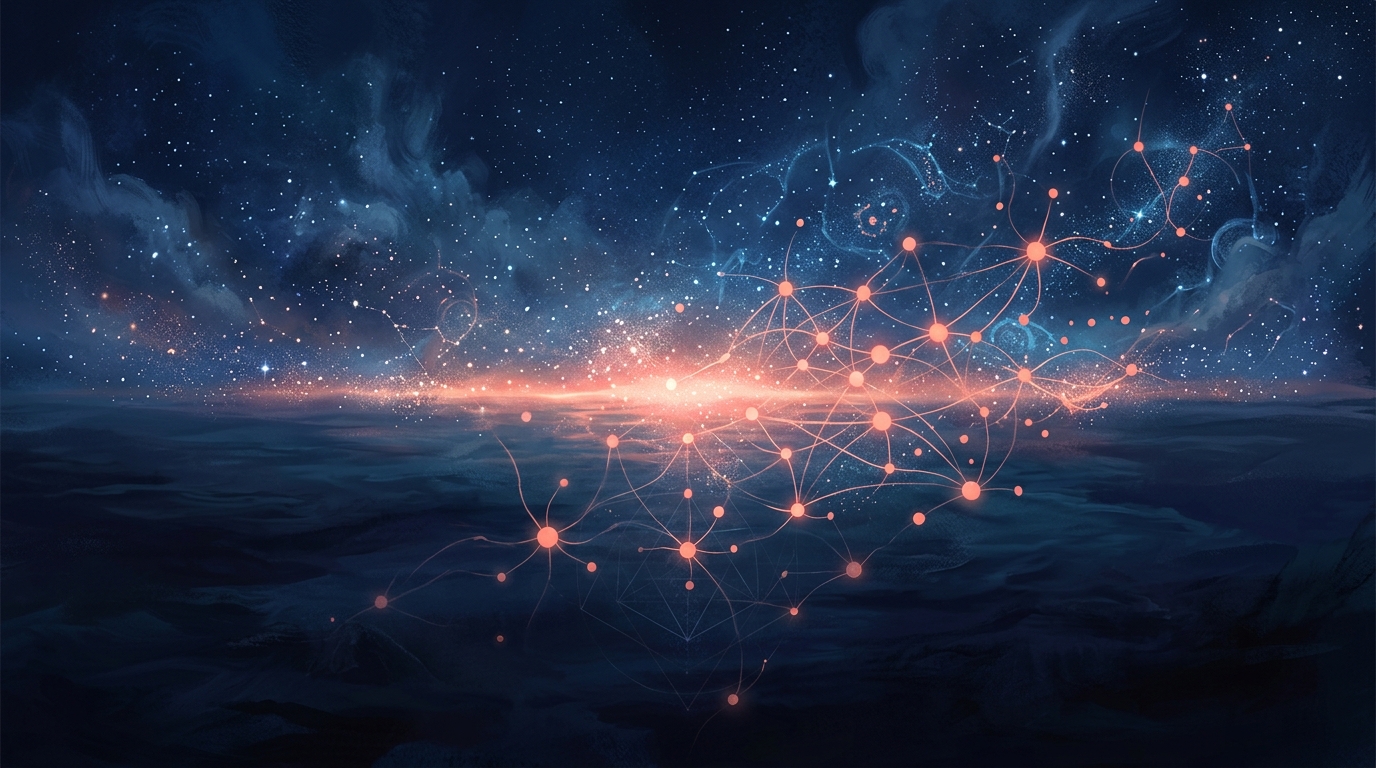
The Quasi-World
On a second reality where meaning lives — and the long line of texts that mapped it. Two interwoven worlds: one builds bodies out of matter, the other builds organisms out of meaning.
There is an old intuition, older than philosophy and stubborn enough to survive it, that the world we touch is not the only world. Not a heaven stacked above it and not an afterlife waiting at the end of it, but a second reality running alongside this one, interwoven with it, pressing against it at every point — a world we reach not with the hands or even quite with reason, but with the imagination. Call it the quasi-world: the world of the imaginal.
This essay takes that intuition seriously and follows it where it leads. The claim is simple to state and strange to hold: there are two interwoven worlds. The material world builds bodies out of particles. The quasi-world builds something else out of something else — and it is there, not here, that meaning actually lives. What follows is an attempt to map that second world, and to show that nearly every piece of the map has been drawn before, by people who were not fools.
Two worlds, interwoven
The first thing to insist on is that the quasi-world is real, and that it is not sealed away. It interpenetrates the material world. What happens in one bears on the other.
The most careful modern account of this belongs to Henry Corbin, who spent his life recovering the mundus imaginalis of Persian Sufism — the 'alam al-mithal. Corbin fought against the modern reflex that would call this realm "imaginary" in the sense of made up. His word was imaginal: a world that is ontologically real, with its own extension, its own dimension, even its own geography — the mystical cities of Jabalqa and Jabarsa, the green earth of Hurqalya, the cosmic Mount Qaf. It stands between the world of the senses and the world of pure intellect: more subtle than matter, less abstract than thought. It is perceived not by the eyes and not by reason, but by a third faculty — the active imagination, which Corbin held to be a genuine organ of knowledge, not a toy.
This is the quasi-world precisely: a real intermediate realm, neither matter nor mere idea, that the imagination touches, and that remains interwoven with this world rather than sealed off from it. Spirits descend into it and take form; forms ascend through it and are spiritualized. Ibn Arabi named the in-between zone the barzakh — the isthmus, the place where two seas meet without mixing, where the immaterial puts on shape and the material is made spirit.
So the notion is not eccentric. It sits inside one of the oldest and most carefully worked-out cosmologies in the world. The task is to build it out.
The building blocks
Begin with the fundamental unit. Imagine it not as a dead little billiard ball but as something that reaches — a particle with arms, made to join, with relation built into its nature. Picture it, say, with eight arms: eight directions of joining, out of which it bonds into molecules, which build into organisms.
A reaching, relational unit is a very different starting point from inert matter, and it has a distinguished pedigree. Leibniz built his entire metaphysics on it in the Monadology: the ultimate units of reality are monads, and each is not lifeless stuff but a point of perception, a "living mirror" reflecting the whole universe from its own angle. Reality is composed of units that already, in their minute way, perceive and relate. If the brick already has an inside, then organisms made of bricks having insides is no longer a mystery.
The eight in particular recurs wherever people try to name the world's first elements:
- In the Egyptian cosmology of Hermopolis, the world begins with the Ogdoad — eight primordial beings, four pairs, who rise out of the formless primordial waters and bring the ordered world into being. Eight, emerging from the void, forming everything.
- In the I Ching, all of reality is generated by the bagua — the eight trigrams, eight fundamental forces whose combinations spell out the ten thousand things.
- In Gnostic and Hermetic thought, the Ogdoad is the eighth heaven, the sphere of fullness above the seven planetary spheres — the realm reached after passing through the seven.
The development this invites: the arms as eight directions of relation — eight elemental ways a unit can bond, out of which both worlds compose their molecules and their organisms. The material world uses them to build bodies. The quasi-world uses the same elemental moves to build something else.
The organisms of the quasi-world
The traditions that took the imaginal seriously almost all agree on one point: it is populated. Corbin's imaginal world is not empty scenery but a place full of beings — forms-in-suspense, presences with their own life. The only question is what kind of life they have.
Several texts offer candidates, and they may be describing one thing from different angles:
- Theosophy put it most literally. Annie Besant and C. W. Leadbeater's Thought-Forms (1901) argued that every strong thought and feeling generates an actual form in a subtle realm — a being with shape and color, born from mind, that persists and acts. Organisms made of meaning rather than matter: that is the book's entire thesis.
- Tibetan Buddhism has the tulpa — a being brought into existence and sustained by concentrated thought, which can take on a measure of independence.
- The Western magical tradition has the egregore — an entity generated and fed by a group's shared attention, which then exerts its own influence back on the group.
- Carl Jung reached the same territory through psychology and named it carefully: the psychoid. For the late Jung, archetypes are not merely patterns in a single skull; they are autonomous, quasi-living structures at the border of psyche and matter. "The gods have become diseases," he wrote — meaning the old beings did not vanish; they went on acting through us under new names.
A possibility worth holding: that the organisms of the quasi-world are made of meaning the way bodies are made of matter — and that what we experience as a strong idea, a recurring obsession, a collective mood, a "spirit of the age," is what one of these beings looks like from the material side. Not metaphor, but the same organism seen from across the barzakh.
Where meaning lives
Here is the heart of the vision: the quasi-world holds meaning, which the material world cannot hold.
This crosses from mysticism into hard philosophy, and the company is serious. Plato placed the realm of Forms — the perfect, intelligible patterns — outside the material world precisely because matter can hold only copies, never the meanings themselves. Whitehead, in Process and Reality, called them eternal objects: pure potentials, the full range of what could be, which "ingress" into actual things and lend them their character. Meaning lives in the realm of possibility; matter borrows it.
Then, strikingly, modern and decidedly non-mystical philosophers backed into the same room. Gottlob Frege argued that thoughts — the contents of true propositions — must inhabit a "third realm" that is neither physical nor private-mental, because they are objective and shared yet have no mass and no location. Karl Popper called it "World 3": the world of meanings, problems, and theories, as real as the physical World 1 and the mental World 2, and able to act back upon both.
So the claim that meaning lives in another world, not in matter, is not a soft feeling. Hard-nosed logicians arrived at the very same structure because they could not make meaning sit anywhere in the physical world either. The quasi-world is, among other things, Frege's third realm with the lights on — not a dry storehouse of propositions but a living, populated place.
Angels and demons: the active layer
In nearly every developed cosmology, the realm between source and matter is not merely a place; it is staffed. It has agents whose entire function is to carry, transmit, and animate — to make the difference between a dead diagram of worlds and a living circulation between them. This is the office of what the traditions call angels and demons.
- Pseudo-Dionysius the Areopagite, in The Celestial Hierarchy (5th–6th century), gave the West its model: nine orders of angels in three ranks, whose work is mediation — the passing of divine light and form down the chain, from the source, through the ranks, into the world. Angels are not decoration; they are the cosmos's circulatory system, the means by which meaning gets from the upper world into the lower one.
- Neoplatonism — Plotinus, Proclus, Iamblichus — populated every level of emanation with intelligences and daimones, the beings through whom the higher acts on the lower. Iamblichus's On the Mysteries lays out the whole staff: gods, archangels, angels, daimons, heroes, each a rung in the transmission.
- Kabbalah supplies the fullest two-sided version. The sefirot are the channels through which the infinite (Ein Sof) pours into creation — the formative, "angelic" agencies. Their shadow, the qliphoth — the "shells" or "husks" — are the deforming counter-agencies: form that has hardened, emptied, turned parasitic. Two staffs, one building the worlds toward life, one dragging them toward death.
- The Yezidi heptad fits the same office: the seven angels, with Tawûsî Melek at their head, as the actual administrators of the world — not symbols of God but God's working hands within creation.
The development this opens: if angels and demons are the agents of passage between the worlds, then they are exactly what would tend the organisms of the quasi-world, and exactly what would carry meaning across the threshold into matter — or fail to, or corrupt it on the way. The angel is the courier who delivers the meaning intact. The demon is the one who counterfeits it, or devours it, or delivers an empty shell. The difference such agents make is whether the meaning that reaches the material world arrives alive or dead.
The void at the beginning
The boldest move in this cosmology is to read the opening of Genesis as a description of the quasi-world itself — to say that the void at the beginning is the second reality, in its unformed state.
The reading has deep backing. Genesis 1:2 calls the earth tohu va-vohu — usually "formless and void," but in the mystical tradition this is not emptiness. It is un-form: the pregnant, undifferentiated fullness before differentiation; the deep (tehom) over which the spirit-wind (ruach) hovers. Everything that will be is already present, unformed, waiting to be drawn out.
The Kabbalists built an entire metaphysics on this:
- Before creation there is Ein Sof, the Infinite. To make room for a world, the Infinite performs tzimtzum — a self-contraction, a withdrawal that opens a void, a space. Creation happens into that void. The void is not absence; it is the made room in which form can appear.
- The doctrine of tohu and tikkun tells of a "World of Chaos" (olam ha-tohu) preceding our ordered world, whose vessels could not hold the divine light and shattered — shevirat ha-kelim, the breaking of the vessels — scattering sparks of meaning down into matter, where they wait to be gathered and repaired. A prior world of un-form, breaking, seeding this one with trapped meaning: set beside the idea of a quasi-world holding the meaning matter cannot hold, the parallel is electric.
Other traditions place the same void at the origin and agree that it is full, not empty: the Egyptian Nun, the primordial waters from which the eightfold Ogdoad rises; the Gnostic Pleroma, the "Fullness" from which the aeons and all reality emanate; the Tao of the Tao Te Ching, "the nameless, origin of heaven and earth," the empty source that is inexhaustible.
The version this yields: the void of Genesis is the quasi-world in its unformed state — pure potential, pure meaning not yet carried across into form. Creation is the ongoing drawing-out of form from that void by the agents who staff the passage. And the quasi-world reached now is that same primordial fullness, still present, still beneath everything, still the place the meaning comes from. Not an event that happened once at the start. The beginning is always underneath.
The stars
The stars belong in this, and the traditions wove them in long ago. In Plato's Timaeus, the maker assigns each soul to a star before birth, and the stars are visible gods — the points where the upper world shows through into the night sky. In Gnostic and Hermetic cosmology, the seven planetary spheres are governed by archons; the soul descends through them into a body and must reascend through them after death — the stars as the gates between worlds. The Hermetic Emerald Tablet gives the structure its motto: as above, so below.
In a two-worlds cosmology the stars become the visible seam between the realms — the place where the quasi-world comes closest to showing through. They are at once the furnaces that forged the matter of every body and the ancient symbols of the agents and orders of the other realm: the point where the material story (we are made of stars) and the imaginal story (the stars are the gates and the gods) touch. In such a vision the two stories would have to touch somewhere, and the night sky is where they do.
The vision, gathered
Set in a single line, it holds together:
There are two interwoven worlds. Both are built from fundamental, reaching units. The material world builds bodies from them; the quasi-world builds organisms of meaning. That quasi-world is where meaning lives, because matter can carry only copies. It is staffed by agents — angels and demons — who carry meaning across the threshold into matter, or counterfeit and devour it. And the whole quasi-world is, in its unformed depth, the void of Genesis: the full emptiness from which everything is continually drawn out, still here, still underneath, with the stars as the seam where it shows through.
The kindred texts, gathered for anyone who wants to go to the sources:
- Henry Corbin, Mundus Imaginalis and Alone with the Alone — the imaginal world and its geography; Ibn Arabi — the barzakh.
- Leibniz, Monadology — the reaching, perceiving fundamental units; the Egyptian Ogdoad and the I Ching bagua — the eightfold first elements.
- Besant & Leadbeater, Thought-Forms; Jung on the psychoid and the archetypes — the organisms of meaning.
- Plato's Forms; Whitehead's eternal objects; Frege's third realm; Popper's World 3 — where meaning lives.
- Pseudo-Dionysius, The Celestial Hierarchy; Iamblichus, On the Mysteries; the Kabbalistic sefirot and qliphoth; the Yezidi heptad — the agents of passage.
- Genesis 1; Kabbalah's Ein Sof, tzimtzum, and the breaking of the vessels; the Egyptian Nun; the Gnostic Pleroma; the Tao Te Ching — the full void at the origin.
- Plato's Timaeus; the Gnostic planetary archons; the Hermetic Emerald Tablet — the stars as the seam.
And the questions the vision leaves open, which are the better part of it:
- What are the arms of the fundamental unit — eight directions of relation, or some other number? And does the quasi-world bond its units by the same set, or by a different one?
- If the organisms of the quasi-world are made of meaning, do they evolve? Are there ecologies there — predators, symbioses, the parasitic (the demonic) feeding on the formative (the angelic)?
- If the void of Genesis is always underneath rather than once-at-the-start, then creation is still happening, continuously. What is the human role in it? Are human beings themselves one of the places the passage runs — one of the seams, like the stars?
These are not loose ends to be tied. They are doors. The map is unfinished on purpose.
Join the discussion on Telegram!

Alösha
Building community platforms, teaching salsa, writing to find my people.