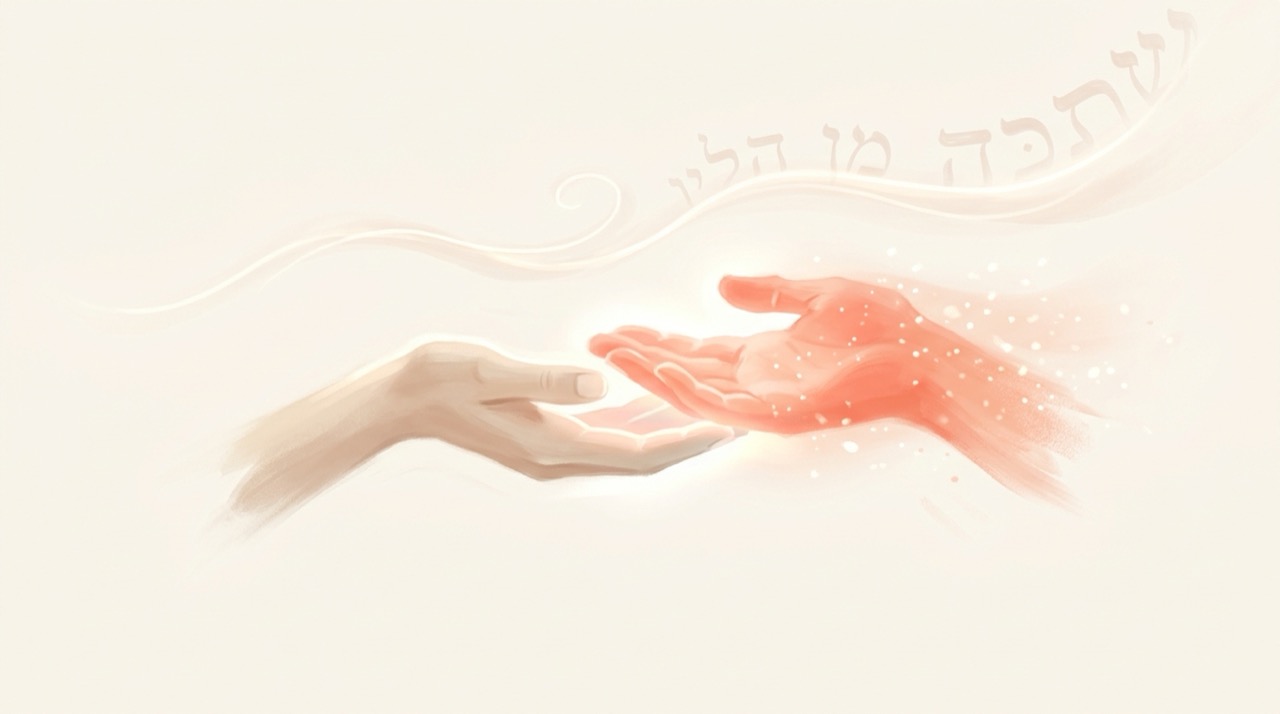
Two Hands of the World
Why do some peoples write left to right and others right to left? An essay on the two hands of the soul — analysis and embrace, IQ and EQ, the two pillars of Kabbalah — and a people who refused to let one hand strangle the other.
An essay on writing, hemispheres, and a people who kept both hands
There's a question that sounds childish until you sit with it: why do some peoples write from left to right, and others from right to left? We treat it as a technicality, a matter of habit, like which side of the road you drive on. But the direction in which the hand draws the pen across the page is the direction in which the mind leads a person through the world. Look closely, and inside that small thing a whole map of the soul is hidden.
Writing left to right is the way of the arrow. Letter after letter, word after word, cause toward effect; time laid out in a line, like rails running to the horizon. This is the motion of the builder and the bookkeeper, the motion of law: break the whole into parts and set the parts in a row. Call it the left hemisphere, call it IQ, call it logos — the name doesn't matter, the gesture does. It is the hand that divides in order to understand.
Writing right to left is the way of return. You move not from the beginning toward the end but back toward the beginning, homeward, against the arrow's flight. And here is a detail that takes the breath away: Hebrew is written with consonants alone. The vowels — the breath of a word, its soul — the reader fills in himself, from within, by feeling, by context. To read, it is not enough to know the letters. You must guess the whole before you can take apart the parts; you must already know the meaning a little in advance. This is the gesture of the other hand — to grasp the gestalt, to sense before you can prove. Eros before analysis. EQ before IQ. The hand that embraces in order to know.
And here is the first thought that unfolds from such a small thing: a people that has read from right to left for a thousand years trains the other hand of the soul. Not better, not worse — the other one. And that training leaves its mark.
The map was drawn long ago
The astonishing part is that you don't have to invent this map through neuroscience. The very people in question drew it themselves — long before the words "hemisphere" and "lateralization" existed.
In Kabbalah the world stands on three pillars. The right pillar is Chesed: mercy, expansion, abundance, flow, the open palm that says give. The left pillar is Gevurah: judgment, severity, boundary, form, the palm that says no, enough, here is the limit. And between them stands the middle pillar — Tiferet, beauty, balance — the place where the two hands meet and hold one another.
Look at this. Thousands of years ago it was already said, what we today clumsily phrase as the standoff between feeling and logic, heart and reckoning, EQ and IQ. Only the ancient tradition was wiser than our pop psychology: it did not divide people into the "right-brained" and the "left-brained," did not pin labels on them. It spoke of two hands of one body, and of how all wisdom lies not in choosing one hand but in holding both and finding the middle. It is no accident that the right hand in Hebrew — yamin — also means strength, and blessing, and the side from which light comes. "The right hand of God" is not a metaphor of omnipotence; it points to the hand by which the world is given rather than taken.
Where the music comes from
If you accept this map, one riddle of history stops being a riddle.
Where does so much music come from in one small people? Why was the Soviet song — the kind that still takes you by the throat today — so often written by Jews: Dunayevsky, Blanter, Frenkel, Matusovsky, Bernes? You can explain it socially: the tsarist bans fell, the conservatories opened, and talent poured through the open doors. That is true, and it matters. But beneath the social truth lies a deeper one.
Music is the right hand of the world in its purest form. You cannot lay it out in letters and read it left to right. You have to catch it whole, with the body, before you understand it; it enters a person bypassing the intellect, straight under the breastbone. And a people that prayed in song for centuries, whose cantorial lament in the synagogue and klezmer fiddle at the wedding carried everything that cannot be said in plain words — that people carried within itself a trained, inherited capacity to translate pain and joy straight into sound. And when the doors finally opened, what poured into song was not merely talent — it was this intonational memory, this right hand. That is why "Cranes" does not inform you of grief but makes you live it. This music was written by that very hand — the hand of return, the hand that writes from right to left.
Wine and bread
And the same pattern lies on the Sabbath table, in the two things this whole conversation began with: wine and bread.
What sanctifies the chief hour of the week? Not a text. Not a proof. Not a logical conclusion. Wine — taste in the throat — and bread — the warmth of the braided challah in the hands. The holiest time enters a person through the senses, through the body, through the shared table where people sit side by side. Through the right hand.
And the Torah? The Torah is law, structure, the left pillar, the strict form of the letter on parchment. But it must enter a person through the right: through the Sabbath evening, through wine and bread, through the verse read aloud in song. And in this lies the genius of the whole construction. The people built the very week as a pendulum between two hands: six days of counting, of work, of writing left to right — and one day of taste, of presence, of writing right to left. Not "either/or," but rhythm. Not the choice of a hand, but the breathing between them.
Both hands
Here is where it all converges. Most "progressive" civilizations went one way: linear writing, linear time, linear reason. They gave their preference to the left hand — to divide, to count, to build — and little by little forgot how to use the right, the one that embraces and hears the whole. This people kept both. It did not let the law strangle the music, and did not let the music dissolve the law. That is why the rabbi-logician and the fiddler-mourner live in it together, the Talmudic argument over a comma and the melody that brings a hall to tears.
So the intuition you started with — that right and left, hand and hand, IQ and EQ, hemisphere and hemisphere somehow rhyme — is no mistake and no play on words. You have felt out a very ancient map. The world is given to us in two hands. And all wisdom is not in deciding which one is the master, but in knowing which hand to take with, and in which hour.
Join the discussion on Telegram!

Alösha
Building community platforms, teaching salsa, writing to find my people.