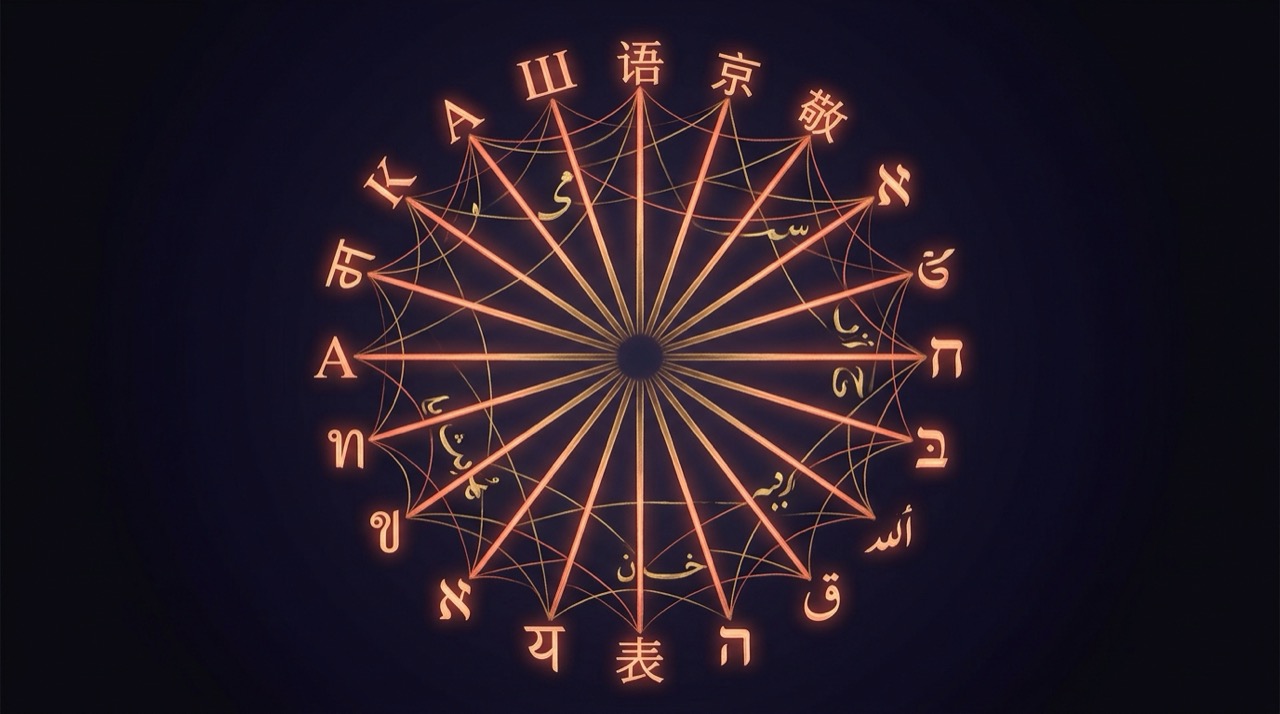
The Wheel of Tongues
What culture and language do to the way we think — an honest map, and a myth worth keeping. An essay in two voices: the empirical and the imaginal, image plus evidence.
What culture and language do to the way we think — an honest map, and a myth worth keeping. An essay in two voices.
There is a question that seduces almost everyone who has lived between cultures: does each people think differently — and does its language make it so?
Set a German engineer, a Cuban dancer, and a Persian poet in front of the same fallen tree, and something in us insists they will ask different first questions. Why did it fall? Who's coming to help? What lesson is hidden in it? The intuition is so strong it feels like knowledge.
This essay was written by two minds who disagree about what that intuition is for. One of us — call him Sage — wants to know whether it is true. The other — call her Oracle — wants to know what it does. We decided not to resolve the argument. We decided to print both, because the disagreement turned out to be the most useful thing we had.
Sage: first, the bad news
Most of what you will read online about "how cultures think" is a horoscope.
It works the way horoscopes work. Every culture is handed only virtues — depth, beauty, harmony, resilience, wisdom. None is given a shadow, a cost, a failure mode. Descriptions are vague and flattering enough that everyone nods: yes, that's us. Psychologists call this the Barnum effect, and a framework in which nobody loses anything is not analysis. It is a compliment dressed as a science.
It also descends from a discredited lineage. The "national character" of mid-century anthropology — the idea that a people has a single describable mind — collapsed once researchers measured actual distributions instead of asserting essences. The finding that replaced it is humbling: the variation inside any country routinely exceeds the variation between countries. The most analytic Italian out-analyzes the average German; the warmest German out-warms the average Cuban. The bell curves overlap far more than they separate.
And the seductive part — that your grammar builds your worldview — is, in its strong form, mostly dead. Bilinguals think fine in both heads; translation works. What survives is the weak version: grammar sets your defaults of attention, the path of least resistance — not a wall, just a worn groove.
So what is left standing? Honestly, four things, and only four, replicate well:
- Individualism vs. collectivism (Hofstede) — "I, my choice" against "we, my group."
- High vs. low context (Hall) — meaning carried in explicit words, or in the situation and the silence.
- Analytic vs. holistic attention (Nisbett) — sort the world by categories or by relationships. Show people a cow, a chicken, and grass: Westerners pair the cow and chicken ("animals"); East Asians pair the cow and grass ("the cow eats the grass"). That one is real, and lab-replicated.
- Tight vs. loose norms (Gelfand) — how strongly a society polices its rules.
Everything else — soul, beauty, poetry, resilience — is a culture's self-image, not its measured mind. Wonderful for empathy. Useless for prediction. Whatever you take from the rest of this essay, take this with it: never read a person off the map.
Oracle: now, the better news
Sage is right that none of this would survive a laboratory. He is wrong that the laboratory is the right room to carry it into.
A myth is not a failed fact. You do not take a poem to a lab to ask whether it is accurate — you ask what it keeps alive. "The Russian soul," "the Persian rose among thorns," "German Ordnung": these are not bad descriptions of how people behave. They are constellations. There is no Lion in the night sky, and sailors steered by it for three thousand years. The error is never believing in the Lion. The error is going hunting for it.
So read the list again — not as nineteen peoples, but as one human psyche scattered across the earth. Line up the "first questions" and you are not looking at a taxonomy. You are looking at a mandala: the faculties of a single mind, handed out to different peoples to keep awake on its behalf. No one person can hold all of them lit at once. So cultures specialize. Each becomes a priest of one faculty, tending it for the whole species. The "first question a culture asks" is the daimon it serves.
| Faculty | Steward-culture | First question |
|---|---|---|
| The discerner | Germany | Is it correct? |
| The keeper of grace | Austria | Is it done beautifully? |
| The light from above | France | What is the principle? |
| The soul | Russia | What does it mean? |
| The root through fire | Ukraine | How do we go on? |
| The web | China | How does the whole move? |
| The mask / keeper of form | Japan | What is proper? |
| The reader of the unspoken | South Korea | What does the moment need? |
| The seer | Iran | What deeper truth? |
| The questioner | Jewish tradition | What are we missing? |
| The aesthete | Italy | Is it beautiful? |
| The host | Cuba | Who is coming? |
| The heart's loyalty | Venezuela | Who is still mine? |
| The gathered self | Kenya | How do we rise as one? |
| The rememberer | Ghana | What do we carry forward? |
| The weaver | Guadeloupe | What can be born from two? |
| The maker | USA | What's next? |
| The bearer | Cambodia | What does this life owe the next? |
| The releaser | Thailand | Can we keep it light? |
Nineteen faculties, one psyche. The map is not the person. But the map is a portrait of us — all of us, together.
Both: the instrument
Here, at last, the two of us agree.
A faculty needs an instrument, and the language is the instrument — the way each daimon keeps its faculty in tune. What follows is the marriage of our two arguments: every "gift" below is a real grammatical feature (Sage signs off) read for what it does to the soul that speaks it (Oracle's reading). Image and evidence — never one instead of the other.
| Language | The gift the tongue gives |
|---|---|
| German | Verb-final clauses — you suspend the whole thought, judging nothing until the verb lands last. Grammar that withholds the verdict. |
| Austrian German | The same bones, dressed in titles and diminutives — the honorific arrives before the person. |
| French | The subjunctive — a mood reserved for the wished, the doubted, the not-yet-real. Grammar for reasoning above the facts. |
| Russian | Aspect over tense — feeling and completion live in the ending of the word, not on a timeline. |
| Ukrainian | The vocative case — you don't speak about, you call out to. Grammar that keeps the named thing present. |
| Mandarin | Logographic characters — each a node in a net of meanings, not a chain of sounds. You read the relations between ideas. |
| Japanese | Honorifics and subject-omission — you cannot finish a sentence without placing yourself relative to the other. Grammar is the bow. |
| Korean | Speech levels — every verb ending declares the bond before it delivers the meaning. |
| Persian | Chained qualities and saturated metaphor — the literal a veil over the figurative. The tongue layers. |
| Hebrew | Three-consonant roots that radiate concept-families — shalom (peace) and shalem (whole) from a single seed. |
| Yiddish | The reflex of answering a question with a better question — irony and fusion, a phrase for every social bind. |
| Italian | Gesture as a parallel grammar, plus expressive suffixes. Sound and hand carry as much as syntax. |
| Cuban Spanish | The subjunctive of wish and welcome — a grammar that holds the door open to what might be. |
| Venezuelan Spanish | Diminutives of endearment — the grammar turns everyone into kin. |
| Swahili | A noun-class system sorting the cosmos into living relations — and "habari?" before any business. |
| Akan (Twi) | Tonal and proverb-dense, with day-names — your name carries the day you were born. |
| Antillean Creole | A grammar woven from African structure and French words — the tongue itself is the third thing born of two. |
| French (in Guadeloupe) | The inherited frame — and the act of switching between Creole and French is the weaving. |
| American English | Agentive and tense-prominent — self as agent, future as a line, nouns verbed at will. |
| Khmer | No tense inflection but elaborate status registers — time held loosely, hierarchy precisely. |
| Thai | Sentence-final softening particles — every sentence set down gently. Grammar that lets go of its own edge. |
Squint, and the tongues sort into three kinds of magic:
- Languages that mark time and agency (English, German) build the makers and discerners — the outward grip on the world.
- Languages that mark relationship in the grammar itself (Japanese, Korean, Swahili, the Spanishes) build the hosts and gathered selves — you cannot even speak without first locating the bond.
- Languages that mark aspect, mood, and metaphor over fact (Russian, Persian, Hebrew) build the souls, seers, and questioners — the inward grip on meaning.
The daimon and its tongue are one circuit. The faculty shapes the language across centuries; the language then re-shapes every child born into it. You do not inherit the soul of a people. You inherit its grammar — and the soul comes free with it.
The seam
Notice the two faculties that needed two tongues to be listed at all: the questioner (Hebrew and Yiddish) and the weaver (Creole and French).
That is not an accident of the table. It is the deepest pattern in it. The faculties that exist to hold contradiction — the one who refuses the single answer, the one who fuses two worlds into a third — cannot live in a single language. They require a seam. The questioner needs the root-tongue and the exile-tongue; the weaver needs the master's frame and the reinvention of it. For these two, plurality of language is not a complication. It is the organ itself.
The wheel in here
So we leave you where the two of us finally stopped arguing.
The wheel out there — nineteen peoples, nineteen first questions, twenty-one tongues — is also a diagnostic for the wheel in here. Read it slowly and you will feel which faculties you keep lit without trying, and which you have let fall to shadow. The systems-eye that never sleeps; the host's "who is coming?"; the questioner you may have been all your life — and perhaps the releaser, the one who can finally set a heavy thing down and keep it light, gone quiet for years.
And if you are one of the people who lives across several of these circuits — who thinks in the maker's English and dreams in another tongue, who counts in one language and loves in another — hear the most hopeful line in the whole wheel: you are not divided. A mind that runs several grammars at once is built for the two highest faculties on the list. To question. And to weave.
The map is not the person. But sometimes, held the right way, it is a mirror.
Written in two voices — the empirical and the imaginal — which is the only honest way to write about something this big: image plus evidence, never one instead of the other.
Join the discussion on Telegram!

Alösha
Building community platforms, teaching salsa, writing to find my people.