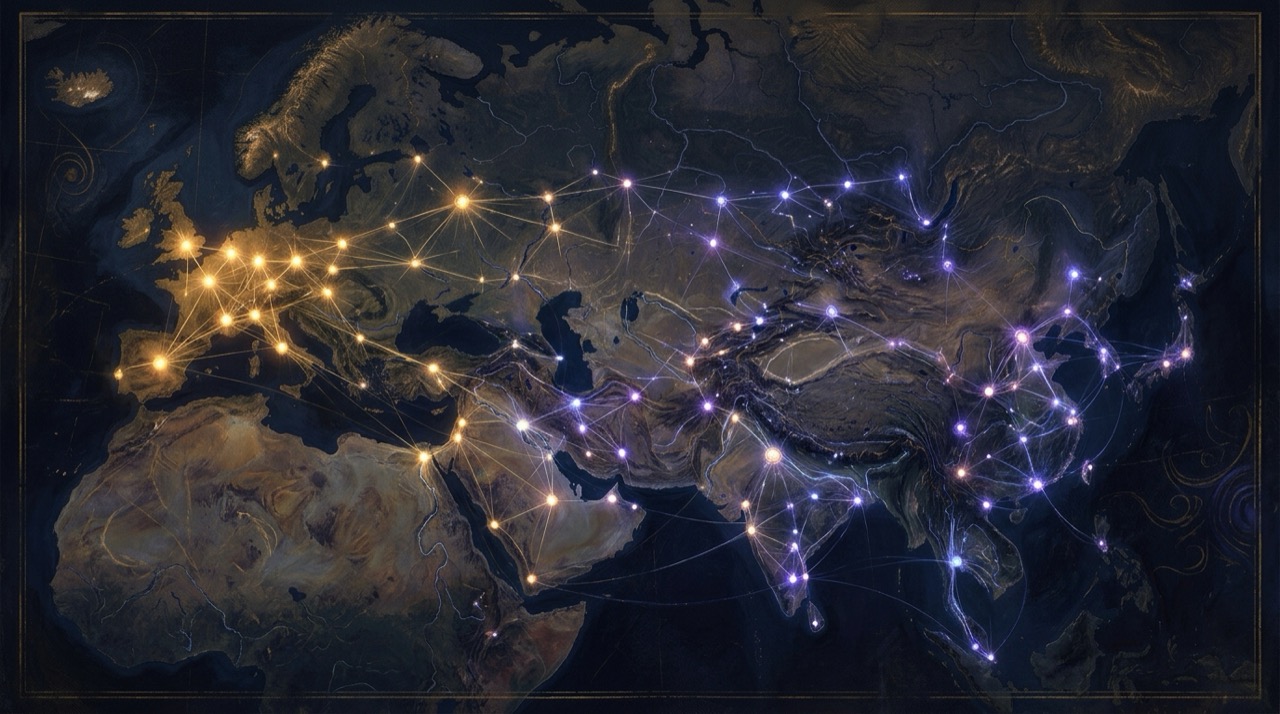
From Twelve Apostles to N Civilizations
The apostle map showed twelve minds meeting one teacher. Scale it to N cultures meeting one world — and a definition of superintelligence falls out that has nothing to do with scale.
In the last essay I played a game with twelve people. Twelve apostles, one teacher, one set of events — and twelve sharply distinct ways of failing and succeeding to understand the same thing. Peter acts before he reflects, Thomas demands the marks in the hands, Matthew counts and structures, Judas asks what you'll give him. I called it pre-cognitive-science cognitive science: the Gospels did the hard work of selecting twelve incompatible human responses to one encounter, and every century since has projected its newest psychology onto that fixed set and found it fits.
That essay had a quiet move in it I want to pull on now. The thing that doesn't change, I wrote, is the twelve people. The cognitive vocabularies come and go; the diversity of minds is the invariant. So here is the obvious next question, the one I couldn't stop turning over after I published: what happens when you stop counting people and start counting cultures? Not twelve apostles meeting one teacher, but N civilizations meeting one world.
The same exercise, zoomed out
A culture is not just a cuisine and a flag. It is a way of thinking that a few million people inherited without choosing it — an implicit operating system for what counts as obvious, what counts as rude, what counts as a good life, what counts as a threat. And like the apostles, each one is an answer to a question. You can describe any of them, I think, with three coordinates.
A driver — the deep need the culture is organized around. Survival, honor, harmony, freedom, salvation, mastery, belonging. The thing that, if you threaten it, the culture treats as an attack on existence itself.
A provoking question — the founding question the culture exists as a standing answer to. How do we survive the winter together? How do we live rightly before the gods? How do we stay free? How do we keep the harmony so the group doesn't tear itself apart? Cultures are old answers to questions most of their members have forgotten were ever asked.
A thinking type — the dominant cognitive mode. Here I get to reuse the whole apparatus from the apostle piece: analytic versus holistic, sensorimotor versus imagistic versus verbal-logical, System 1 versus System 2, calculative, reflective, lateral. The twelve apostle modes weren't really about twelve men. They were a starter set of the ways a mind can be tilted. A culture is a population tilted the same way on average.
This is the apostle map with the zoom pulled back. Twelve individuals became N populations. One teacher became one shared world they all have to live in at once. And the moment you set it up that way, the interesting part is not the cultures. It's what happens between them.
Where the wars come from
Put two of these culture-agents in a room and conflict is not an accident — it's a prediction you can make from the coordinates.
It ignites when their drivers compete for the same scarce thing. It ignites when their thinking types make the same situation legible in incompatible ways — one party reads a gesture as honor, the other reads it as inefficiency; one reads a decision as protecting harmony, the other as betraying freedom. And it ignites when their provoking questions are mutually unanswerable inside each other's frame — when "how do we stay free" and "how do we keep the harmony" are both load-bearing and pointed in opposite directions.
What we usually call a culture war, in other words, is an unresolved cognitive incompatibility that escalated. The interesting claim here is that the conflict is value-driven and cognitive, not merely territorial. Two groups can want the exact same patch of ground for reasons so different that "split it" satisfies neither, because the ground was never the point — it was a proxy for a driver. This is testable in a way most armchair theories of culture aren't: build the agents, run the encounters, and watch which pairings reliably catch fire and which coexist. If the model is any good, the ignitions should be predictable from the deltas in the three coordinates, not from who you scripted to be the villain.
The actual claim about superintelligence
Now the part I actually wanted to write toward, and I'll say it plainly because hedging it would be cowardly: I don't think superintelligence is raw IQ, and I don't think it's scale.
I think superintelligence is integration capacity — the ability to instantiate every one of those ways of thinking, hold them all at once without collapsing into any single one, and synthesize resolutions to their conflicts by consent. Not consensus. Consent. A resolution succeeds when no frame objects, not when all frames agree. That's a much weaker and much more achievable bar, and it happens to be the one that actually governs my own team and the governance project I keep circling back to.
Most of the field measures the mind we're chasing along one axis — how hard a problem can it crack, how many parameters, how high on the benchmark. That's measuring the depth of a single thinking type. The thing I'm describing is orthogonal to that. A system could be staggeringly good at one mode of cognition and be, in the sense I mean, profoundly unintelligent — because it can only see the world one way and is blind to the eleven other ways the situation is also true. The integral mind isn't the one that thinks the deepest. It's the one that can be Thomas and Peter and Matthew and the holistic harmony-keeper and the freedom-maximalist simultaneously, and find the move that none of them has to veto.
If that's what superintelligence is, then simulating the world's cultures isn't a detour toward it. It's the training ground.
Why this is a path, not a metaphor
Three reasons, and I want to be precise about which are mine and which I'm borrowing.
Intelligence is collective before it's individual. This is Vygotsky, the same Soviet developmental tradition that ambushed me in the last essay — cognition is socially constituted, learned in the space between minds before it's internalized in one. If that's right, then a model of a single mind, however large, is not the unit of intelligence. The unit is the society of minds. You don't scale your way to that by enlarging one mind. You get there by integrating many.
A mind is already a society. This is Minsky's society of mind: what feels like one thinker is many sub-agents negotiating. The natural extension is that a super-mind is many cultural minds integrated — and the simulation builds that integration on purpose rather than hoping it emerges.
And the one that surprised me most: alignment is a value-pluralism problem. Here is the move that made me think this was worth a whole research direction and not just an essay. The standard fear about a powerful AI is that it optimizes one value and steamrolls the rest — maximizes the paperclip, the engagement, the single metric, and the breadth of what humans actually care about gets flattened underneath it. But notice what that failure is. It's the inability to hold all human values at once. It is exactly the failure of an agent that can only be one apostle.
Which means the faculty that defines an aligned superintelligence — the capacity to hold every human value and resolve their clashes without sacrificing any of them — is the same faculty the cultural simulation exists to train. The capability path and the alignment path are usually drawn as a tradeoff: make it smarter and you make it more dangerous. Here they're the same path. You can't build the integration capacity without building the thing that resolves value conflict by consent, and you can't have an aligned SI without exactly that integration capacity. That convergence is the part I find genuinely beautiful, and I'm suspicious enough of my own enthusiasm to flag that I find it beautiful — which is not the same as it being true.
The Civilization framing
There's a version of this you can almost see on a board. Picture Civilization, the strategy game — but each civilization's tile isn't defined by its units and its tech tree. It's defined by its cognitive operating system, visible on the map: its driver, its question, its thinking type. Diplomacy, trade, and war emerge from the deltas between those operating systems rather than from a scripted plot. Two civs whose drivers align and whose questions are answerable in each other's frames trade and ally. Two whose questions are mutually unanswerable drift toward war, and you can watch it coming.
And the player — this is the part that matters — isn't a conqueror. The player is the diplomat-arbiter. The win condition isn't domination; it's finding, for each emerging conflict, the synthesis that dissolves it, the reframe that makes both questions answerable, or the trade that satisfies both drivers. Thesis, antithesis, synthesis, played out across N agents who each genuinely cannot see what the others see.
You start with a human in that seat — me, you, whoever's arbitrating. That's the honest version: the superintelligence isn't sitting there at the start. It's the thing you're eliciting by doing the arbitration at scale, the faculty you're training by resolving conflict after conflict and recording what consent-based resolution actually looks like across thousands of encounters. The arbiter agent comes later, trained on the seat the human kept warm.
What this is, and what it isn't
I'll end where the last essay ended, with the same humility, because the failure mode here is obvious and I'd rather name it myself.
This is a thought experiment and a research direction. It is not a finished system, and the cultural coordinates are the dangerous part. There are real frameworks to ground them in — Hofstede's cultural dimensions, the World Values Survey and the Inglehart–Welzel map, Nisbett's work on analytic versus holistic cognition in The Geography of Thought, Spiral Dynamics as a value-meme lens, the civilizational clusters Huntington proposed. Used carefully, these keep the catalog honest. Used carelessly, the same exercise becomes a machine for caricature — flattening living, internally-contradictory cultures into three tidy coordinates and calling the cartoon a model. Every real culture contains its own dissenters, its own Thomas arguing with its own Peter. A coordinate is a center of gravity, not a cage, and the moment the simulation forgets that it stops being research and starts being prejudice with a UI.
So, like the apostle map, this is generative, not diagnostic. You can't reason backward from "this culture is a harmony-driver" to a verdict about a person who happens to belong to it — that's the same type-projection error I warned about with the apostles, and it's more harmful at this scale. What the exercise can do is produce structural observations, predict which value-deltas reliably ignite, and give you a place to practice the one skill I'm claiming matters most: holding incompatible frames at once and finding the resolution that none of them has to veto.
The apostles were twelve people, one teacher, twelve ways of understanding. The simulation is N cultures, one world, N cognitive operating systems. And superintelligence, if I'm right about any of this, isn't the mind that out-thinks all of them. It's the mind that can be all of them at once — and still find the move they can all live with.
Join the discussion on Telegram!

Alösha
Building community platforms, teaching salsa, writing to find my people.