Who Am I? Will, Suffering, and Ikigai
Schopenhauer said the world is a blind will — an all-powerful energy with no direction. The mission of a life is to give that energy its direction. An essay on the one question worth answering, why life is suffering, and the three ways out.
An essay on the will, the question, and the way through
There is one question underneath all the others, and most of a life is spent avoiding it. Who am I? Not the answer you give at a party — the job, the city, the list of things you do. The real one. The question that, if you sat with it honestly, would frighten you a little. Everything in this essay turns on the claim that this question is not philosophy for its own sake. It is the most practical question there is, because the answer to it is your mission, and the mission is the thing that turns a blind force into a life.
The will without a direction
Schopenhauer saw the world as will. Underneath everything visible — the bodies, the striving, the wanting — there is one energy, blind and enormous and tireless, pushing everything forward. It is the force that makes the seed split the stone, that makes the animal hunt, that makes you reach for the thing you want before you have even decided to. It is all-powerful. And it is the source of the suffering, because the will wants endlessly and is never filled: satisfy it and it wants again, a moment later, forever.
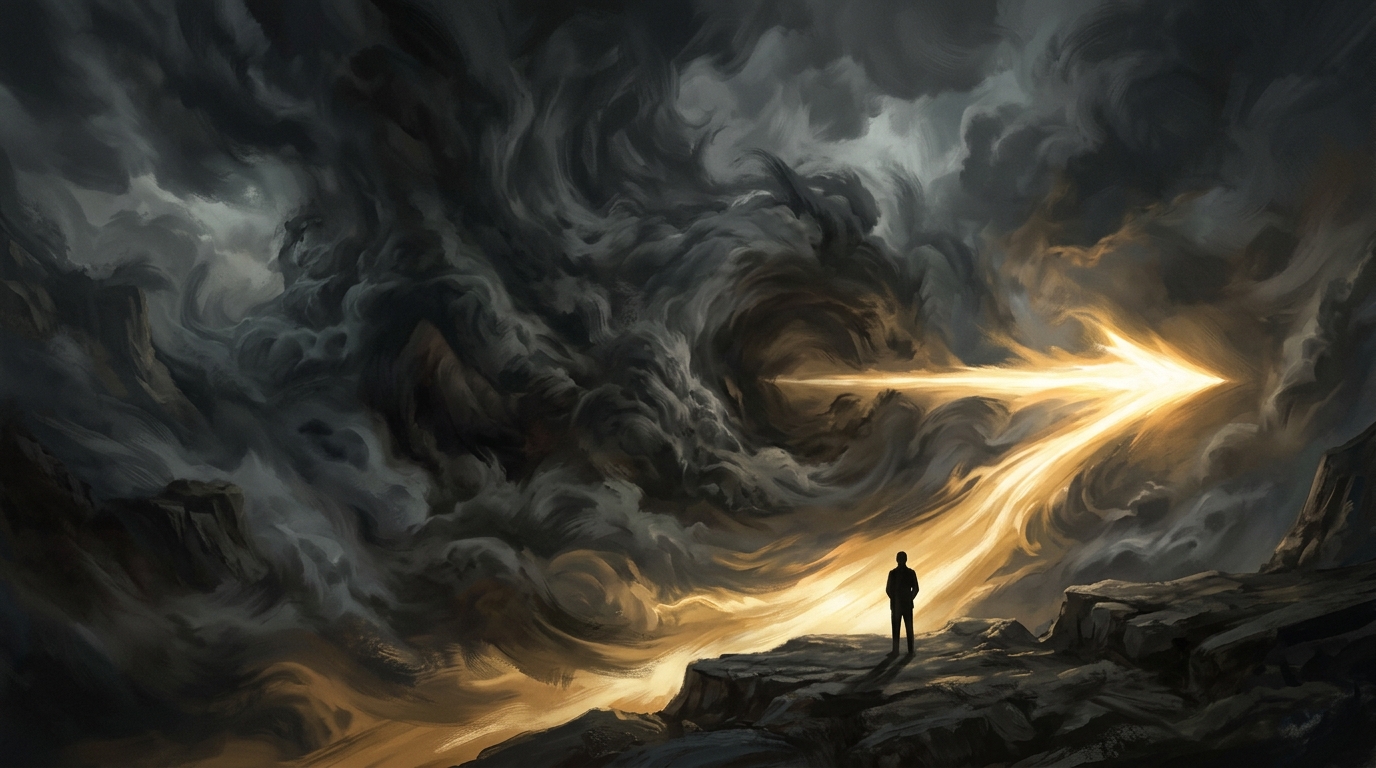
But here is the thing Schopenhauer saw as the trap, which I want to turn into the door. The will has all the power and no direction. It is pure energy with no aim — and energy without aim only churns, only suffers, only wants. The whole problem of being alive is that you are full of this force and it points nowhere.
And this is exactly where ikigai enters. The mission is not a nice addition to a life, a hobby, a thing to feel good about. The mission is the direction given to the will. It is the vector that takes all that blind enormous energy and finally points it somewhere. Ikigai is the answer to the question Schopenhauer left open: what do you do with a force that has everything except a heading? You give it one. You find the single thing that is yours to do — and the energy that was only churning becomes a current that flows.
What is that single thing? It has a precise shape. Your mission is the thing that is very difficult for you, and impossible for everyone else. Not what is easy for you — easy is not a mission, easy is a gift. And not what is merely hard — hard alone is just labour. The mission lives exactly where your specific difficulty meets the world's impossibility: the thing only you can do, and only barely, at the edge of what you are capable of. That edge is the direction the will was looking for.
Life is suffering — and that is the norm
Before the way out, the honest part, the part both Schopenhauer and the old religions agree on: life is suffering. The Buddha opens with it. The scriptures are soaked in it. And we spend our days standing at the sky asking why — why must we suffer, as if suffering were a mistake, a bug, an injustice done to us specifically.
It is not a mistake. It is the norm. It is the baseline condition of being a creature made of want. The moment you stop treating suffering as an outrage to be explained and start treating it as the weather you live in, something relaxes. You stop spending your strength on the protest. The question was never why is there suffering. The question is what do you do inside it — and there are, I think, three ways through.
The first way out: music
The first is music. Music does something no argument can do: it makes you forget. It reaches in under the thinking, past the churning will, and for the length of a song it simply quiets you. It does not solve the suffering; it suspends it. It is the one place where the wanting stops and you are not reaching for anything — you are just inside the sound, complete for a few minutes, asking for nothing. Schopenhauer loved music above all the arts for exactly this reason: it is the will heard directly, and somehow, heard directly, it stops hurting. This is the simplest exit and the most available. When nothing else works, the music works.
The second way out: empathy — but in the right order
The second is empathy — and this is the teaching of Christ, to turn toward the other, to reconnect. But here the order matters more than anything, and getting the order wrong ruins it.
You cannot truly reconnect with others until you have connected with yourself. To find God, in the language of the old books, means to find your mission — to resolve the one unknown, who am I. That comes first. Start with yourself: answer the question, find the direction of your will, become someone before you try to be of use to anyone. Only then turn outward. The sequence is not optional. The person who runs to others before they have found themselves is not giving — they are fleeing the question, using other people as a place to hide from it. First connect with yourself. Then, and only then, connect with others. That is the second exit, and it is the larger one, because it is the only one that lasts.
And there is a discipline that prepares you for both halves — meditation, the Buddhist way in. It moves in steps. First you disconnect: I am not my emotion. The feeling moves through you, but it is not you; you learn to stand a little apart from it and simply absorb it instead of becoming it. Then you observe: you come to know that this situation will trigger that feeling, and you watch it arrive without being swept off your feet. And then — this is the whole point — you choose your reaction. The feeling is not in your control. The reaction is. I learned this in a small, concrete way once: hungry and on edge through a long day, I disconnected the hunger from the anger, refused to let one become the other, and found I could speak to people with a steadiness I would not otherwise have had. That is the practice. Not the absence of feeling — the space between the feeling and the act.
What we are not responsible for
One more thing the practice teaches, and it is a relief: you cannot control other people's emotions. You can control your own actions, your own behaviour, your reactions — and nothing beyond that line. So you are not responsible for what you do not control. You can influence others, yes — and there the ethics get delicate, because influence shades easily into manipulation. The rule I would draw is this: you may influence another person only if you have found your own mission, only if you know what you are doing and why. If you have not yet answered who am I — if your own will still points nowhere — then influencing others is forbidden, because you will only be spreading your own confusion. Find yourself first. The right to move others is earned by first knowing where you yourself are going.
The one question
So it all returns to the beginning. The will is enormous and blind. Suffering is the norm, not the injustice. And the three ways through are music, which suspends the suffering; empathy, which redeems it; and meditation, which gives you the space to choose. But under all three is the single question, the one that has to be answered first and answered alone: who am I.
Answer it, and the answer is your mission. The mission is the direction. The direction turns the blind will into a current with a course. That is what a life is, when it works: not the absence of the great churning force — you cannot get rid of that, it is what you are made of — but the force finally pointed somewhere. The whole of it, aimed at the one thing that is yours to do. Find that, and the energy that was only suffering becomes the energy that carries you. That is ikigai: not happiness, not comfort, but the will with a direction at last.
Join the discussion on Telegram!

Alösha
Building community platforms, teaching salsa, writing to find my people.