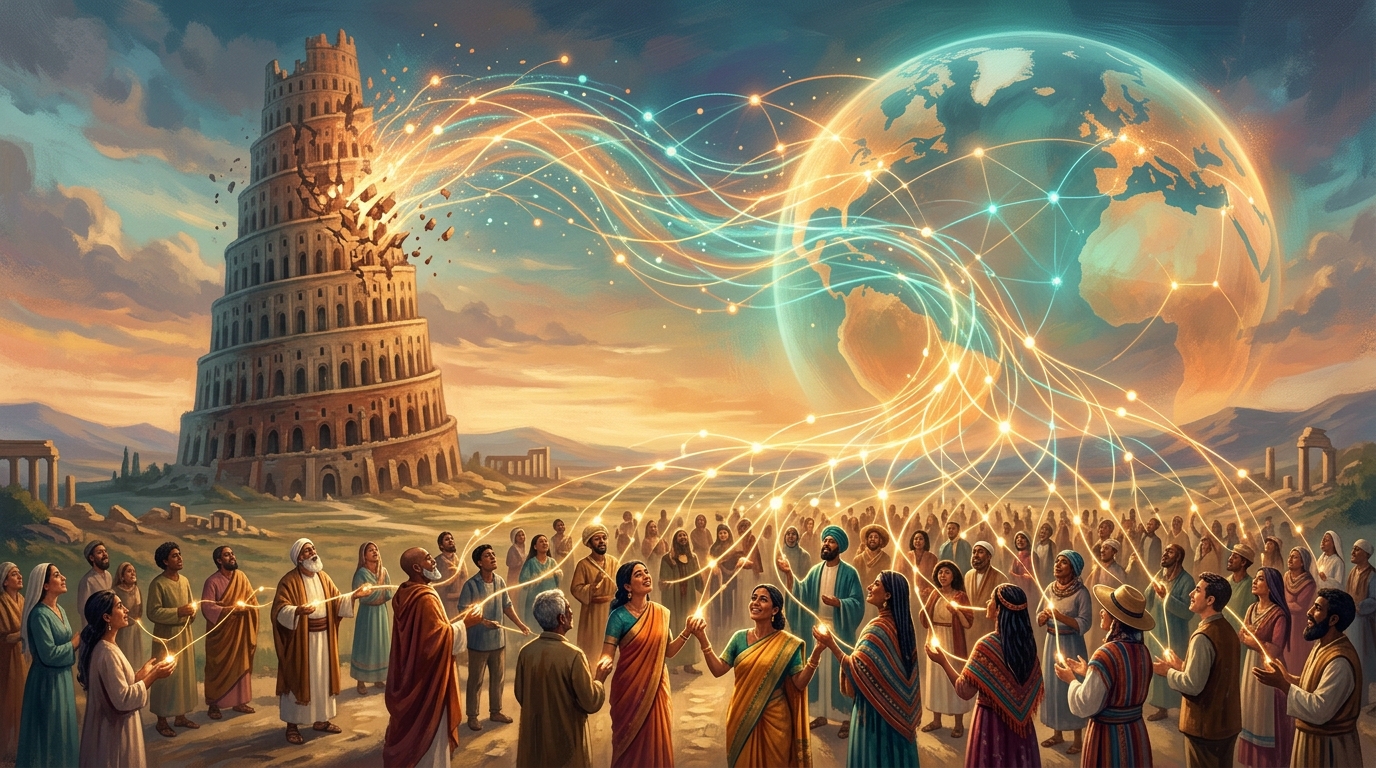
After Babylon: From Nations to Ideas
Nations were a tool for dividing the world. As borders give way to ideas, brands, and mixed teams, the tool may have done its work — and national football is the canary.
We are starting to lose the concept of borders. What anchors people now is less the geographical place and more the corporation, the brand, the idea. So it's worth asking the older question first: where did nations come from in the first place?
Babylon, or divide and conquer
My reading is that most of it traces back to Babylon — and in the way I read the Bible, Babylon stands in for empire, for the Roman pattern of power. The move is divide and conquer. You take one big land and you break it into smaller ones. But splitting the map isn't enough; people still remember they were one. So you give them different languages and different cultures, and over generations they forget that they were ever the same.
Imagine being told: your language is now Latin. On the street, fine — you'll speak Latin, especially once it turns out Latin is useful for trade. That utility is the seed. But home is a sacred place; at home you keep speaking what you feel. Then the empire's grip loosens, its influence fades, and the thing that was imposed starts to drift and mix with what was kept. Out of that mixing a new language is born. The tool of separation keeps working long after the empire that built it is gone.
A nation is a thinking type
Here's what I've come to in my own research: different cultures and different languages are really about different types of thinking. And a thinking type is defined by its provoking question — the first question the mind reaches for.
- Germany — the discerner. The first question is: Is it correct?
- Russia — the soul. The question is: What does it mean?
- Kenya — the gathered self. The question is: How do we rise as one?
- USA — the maker. The question is: What's next?
I hold these loosely — they're a lens, not a verdict on anyone. But it reframes what a nation is. After Babylon, we ended up with many cultures and many languages, and for a long stretch that was simply the norm: develop distinct nations, take pride in being national. We also got the extremes — Germany in the Second World War is the one everyone names, but if we're honest it was never only Germany.
National football is a simulated war
Take national football. Is it about watching, or about playing? Probably it starts with watching: you see the energy and the money pouring in, and you want to step onto the pitch yourself.
But what is national football actually about? It's the nation's team against other teams — how do we play against the others? At its root it's a fight: do we know how to fight other nations? It's a simulation of war. Who would win this battle, who would win that one. At some point we decided that going physical, an actual fight, isn't cool — so we play football instead, so we don't kill each other.
And here's the canary. National football doesn't excite me the way it's supposed to anymore. If the simulated fight between nations stops mattering, that's a signal: the thing it was simulating — us against them, nation against nation — is losing its grip. That was exactly my thinking: we are moving from nations and borders toward ideas, corporations, brands. That is what matters now, more than geography and politics. The long project of sharpening one nation's single question may simply be finished.
Now we mix cocktails
If that's true, then the work ahead is to come together and mix cocktails. Not everyone likes that — you can see the pushback against immigration, the pull back toward closed borders. I understand the friction; it's the friction of a transition. But I think the future is the mix. Borders thin out, and we learn to work in cross-functional teams across cultures, with all the different questions in the same room: Is it correct? What does it mean? How do we rise as one? What's next?
That's not the loss of identity. It's what comes after Babylon.
Have thoughts about this post? Let's discuss it on X!

Alösha
Building community platforms, teaching salsa, writing to find my people.