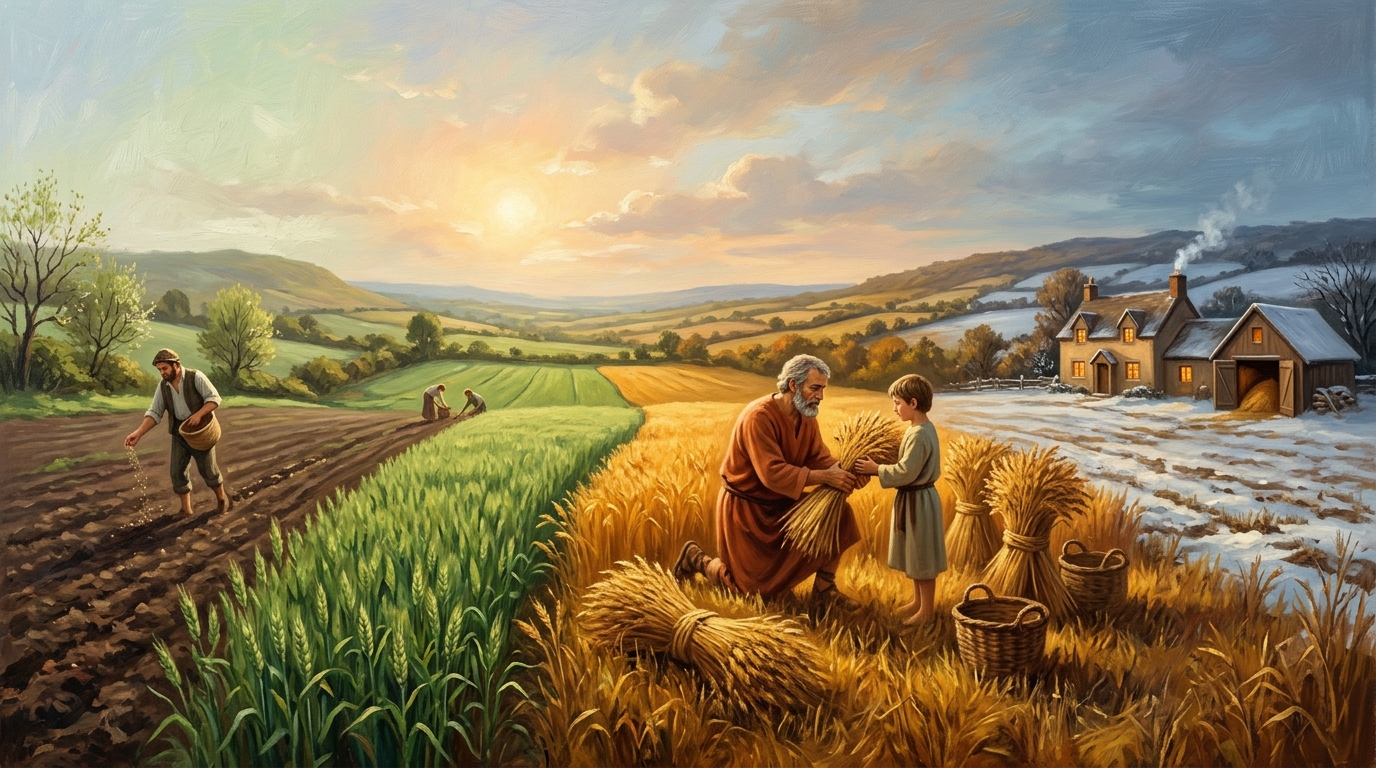
The Four Seasons of Wealth
Babylon, Kiyosaki, and my own reading of the seasons: money is not something you accumulate, it is something you plant, own for a summer, and pass on. Wealth is really a theory of legacy.
Three books about money keep circling the same table in my head: The Richest Man in Babylon, Rich Dad Poor Dad, and The Cashflow Quadrant. People read them as manuals — save this much, buy that, move from here to there. But read together, and read slowly, they are not really about money at all. They are about a season, and about what a man is supposed to do with the harvest before winter comes.
So let me start where money is easiest to misunderstand: at the beginning, in spring.
Spring: you plant, or you don't
Nothing grows that was not planted. This sounds obvious until you notice how many people are waiting for a harvest they never sowed. Clason's Richest Man in Babylon has exactly one non-negotiable rule underneath all its parables: a part of all you earn is yours to keep. Pay yourself first. Keep at least a tenth before anything else touches it.
That tenth is a seed. It is not the harvest, and it is not meant to feel like much. A seed never does. The whole point of spring is that you act before there is any evidence — you put something into the ground on faith that the ground will answer. Most people spend first and try to save the remainder, and the remainder is always nothing, because a life will always expand to swallow whatever is left in front of it.
Spring is the faith season. You plant without proof.
Summer: you own it, and you are responsible
Here is where the second book enters. Kiyosaki's whole reframe in Rich Dad Poor Dad comes down to one distinction: an asset puts money in your pocket; a liability takes money out. The rich buy assets; the middle class buys liabilities it has been taught to call assets.
I read this as the law of summer. Summer is the season of owning — of earth, of responsibility. To own something is not to hold it and admire it. It is to be responsible for it: to weed it, guard it, keep it alive through the heat. An asset is simply a thing you own that is alive enough to feed you back. A liability is a thing you carry that only ever asks to be fed.
Most people never reach summer with money because they never planted in spring, and the few who did plant then spend the whole summer buying beautiful things that eat. The discipline of summer is unglamorous: you tend what you own, and you refuse to mistake consumption for ownership. You are not the richest man because you have the most. You are the richest man because what you have is working, and you are still responsible for it.
Autumn: the harvest, and the meeting
Autumn is fire. It is the strong season — the season of gathering in, of counting, of standing at the end of the summer's labour with something in your hands. This is the season the Cashflow Quadrant is really describing.
Kiyosaki splits every income into four sources: Employee and Self-employed on the left, Business-owner and Investor on the right. The left side trades time and personal effort for money — you own a job, and if you stop, the income stops. The right side earns through systems and through capital — the thing produces whether or not your hands are on it.
The left side is a man still working the field with his own back in autumn. The right side is a man who built something over the summer that now harvests itself. That is the entire migration the book is pointing at: not "work harder," but build something that keeps producing after you step away from it. An investor's money works while he sleeps. A business owner's system works while he is somewhere else entirely. This is what it means to have a real harvest instead of a wage — a wage ends the moment the arm stops swinging.
And autumn is also the season of the meeting. At the end of a real summer — after a man has planted, owned, and been responsible for something — he becomes someone worth meeting. Not before. Attraction, in the old sense, is a response to evidence: here is a man who put something in the ground and stayed with it. The harvest is not only grain. It is the credibility that comes from having finished a season.
Winter: rest, magic, and the reason for any of it
Then comes winter — air, stillness, the season that produces nothing and is not supposed to. Winter is rest and it is magic: the season where what was gathered in autumn is kept, warmed, and quietly prepared for a spring the winter itself will never see.
None of the three books is really about winter, and that is their limit. They are books about accumulation, and accumulation is a summer-and-autumn skill. But wealth that has no winter — no rest, no keeping, no passing-on — is just a bigger pile that dies with the man who stacked it. Babylon tells you to keep a tenth. It does not tell you what the keeping is for.
Here is what I have come to: the keeping is for the next season, which is not yours.
Every idea is a child
I have noticed that I treat business ideas the way a family treats children. A strong idea is a kind of child — you carry it, you are responsible for it, and its whole purpose is to be handed forward. One good idea, owned across a full season, becomes a legacy. And a legacy, by definition, is something you build to give away.
This is the part the money books skip and the old stories never do. The father plants, owns, harvests — and then the real work begins, which is the transfer. And the transfer is strange: the son cannot simply be handed the field. He has to leave the house first. His mind only opens once he is disconnected from where he came from — out in the world, seeing how others do it, discovering a function of his own. Only after he has found something out there can he come home and reconnect — and only then can the father give him the one thing that cannot be found in the world, the knowledge that only the father holds.
That double movement — leave to discover, return to inherit — is the whole mechanism of legacy. Break either half and the chain stops. This is why the old command to honour your father and mother is not sentiment. It is infrastructure. It is the protocol by which a harvest survives the man who grew it.
Wealth is a completed season
So put the three books back on the table and read them as one sentence.
- Babylon: plant — keep a tenth, on faith, in spring.
- Rich Dad: own — buy what feeds you, not what eats you, through the summer.
- The Quadrant: build the harvest so it gathers itself — cross from working the field to owning the system, by autumn.
And then the part none of them wrote: rest, keep, and pass it on — so that the season you completed becomes the seed of a season you will not live to see.
Money, read this way, is not a number and not a pile. It is a season a man is asked to finish honestly: plant, own, harvest, and hand forward. The richest man in Babylon was not rich because he had the most gold. He was rich because he understood that gold, like a field, like an idea, like a name, is only ever held for a summer — and that the whole point of holding it well is to have something worth giving away.
Have thoughts about this post? Let's discuss it on X!

Alösha
Building community platforms, teaching salsa, writing to find my people.