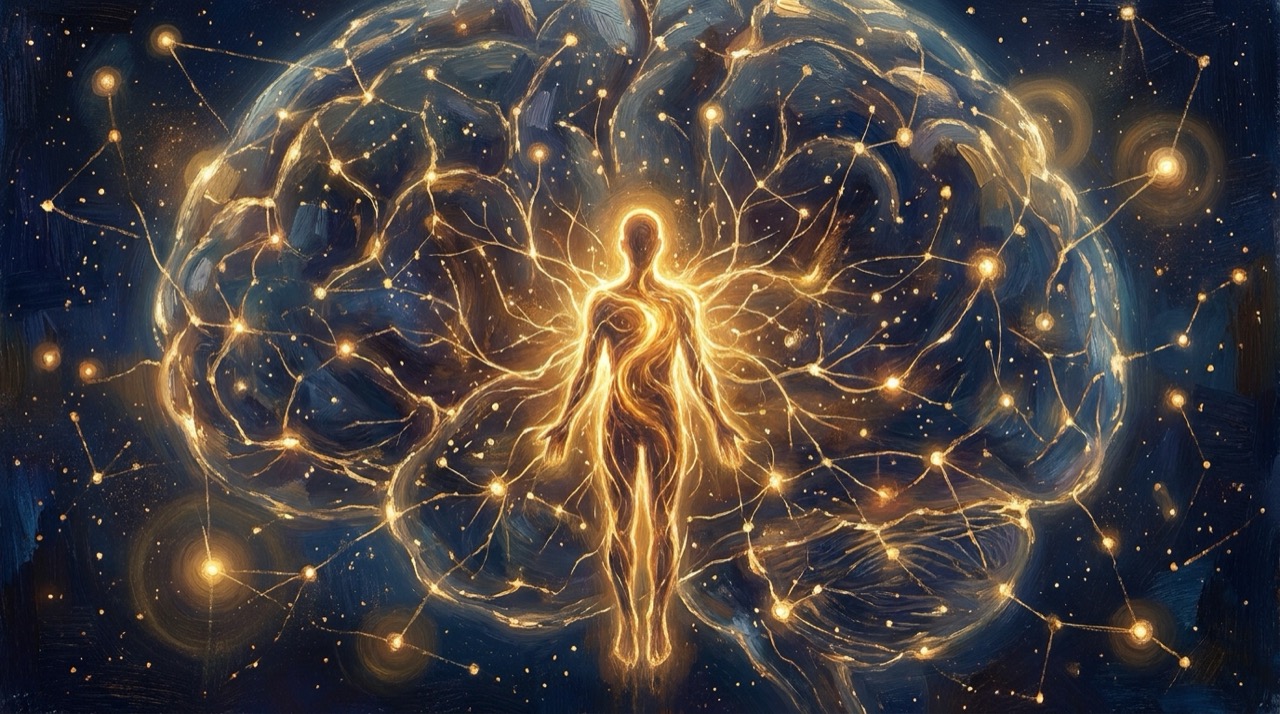
You Are a Neuron in a Larger Mind
A single neuron never authors your thoughts — it fires inside them and dies while they continue. Take that relationship seriously and it rewrites identity, humility, and the fear of death.
There is a single cell somewhere in your brain right now that is, in this exact moment, part of the thought you are having. It does not know that. It cannot. A neuron has no access to the sentence forming in your mind; it only knows its own small electric yes or no, whether to fire or stay quiet, passed to a few thousand neighbours. And yet the thought is real, and the neuron is genuinely in it — not decoration, not audience, but a working part of a mind it will never once perceive.
I keep returning to that image, because I think it is the truest thing anyone has ever said about what you are. Not a metaphor for something else. A description. You are to the mind of something larger what that neuron is to yours — and if you sit with the relationship honestly, it quietly takes apart three of the things we are most anxious about: who we are, how much we matter, and what happens when we stop.
The status of the claim
Let me be exact about what I am and am not saying, because the whole essay turns on it.
The biology is not in dispute: a single neuron does not, by itself, author a thought. Cognition is what happens between cells — in the pattern, the timing, the network — and no individual cell contains the idea it helps produce. A neuron also dies, routinely, while the mind it served goes on thinking. Both of those are plain fact, and I am borrowing them exactly as they are.
What is not established science is the second half — that the Earth, or something larger than any of us, is itself a mind that we are the neurons of. That is the load-bearing hypothesis of a model, not a finding from a laboratory. I hold it as a hypothesis, and I would ask you to hold it the same way. The point of a model like this is not that it has been proven. It is that, once you accept its one assumption, a surprising amount of your experience stops feeling like noise and starts feeling like participation.
So: firm analogy, honest speculation, offered as a lens and not a doctrine. With that on the table, follow where it goes.
You were never the author
We build our whole sense of self around authorship. My thoughts, my achievements, my significance — as if each of us were a small sealed source, generating value from the inside and pushing it out into the world.
The neuron makes that impossible to believe. A cortical cell contributes something indispensable to the thought — remove it and enough like it, and the thought degrades — and yet it is in no sense the author of the thought. The authorship lives in the pattern, in the relationship between it and everything it is wired to. The cell is necessary without being sovereign. It matters entirely, and it owns nothing.
I find this enormous, and strangely relieving. If you are a participating cell in a larger mind, then your significance was never yours to generate in the first place. It was always relational — something that only exists in the firing-together, in the connection to everyone you are wired to. This is why the lonely, sealed-off version of a meaningful life never quite works: you were trying to be the source of a value that, by its nature, only ever appears between. You are not the author of your own significance. You are a place where a larger significance passes through and briefly lights up.
The humility this asks for — and the dignity it gives back
You could hear that as a demotion. So I'm just a cell. Just one of a hundred billion. Interchangeable, forgettable, small.
But watch what the neuron actually is inside the mind. In the instant it fires as part of a thought, that thought cannot happen without it. It is not a spare. It is not waiting in reserve. The whole depends, right now, on this exact cell doing its exact small thing — and at the same time, the cell is emphatically not the seat of the whole. It does not run the mind. It cannot see the mind. Both are true at once, and living inside both at once is the most honest posture I know.
That is a specific and unusual kind of humility. Not the humility of feeling worthless — the neuron is not worthless, the thought needs it — but the humility of being indispensable without being central. You can pour yourself completely into your small firing, give it everything, and still hold, without bitterness, that you are not the point around which it all turns. Most of our suffering comes from getting this backwards: acting central when we are indispensable, or feeling worthless when we are simply not central. The cell has it right. Fully committed, entirely un-grandiose.
And then, death
Here is where the image does its hardest work, and I want to handle it gently, because I am not selling you a comfort I can prove.
We fear death as deletion — the total erasure of the one thing we are sure is real, our own inner point of view. And within the sealed-source picture of the self, that fear is exactly correct: if you are the private author of your own significance, then when you go, the author is gone and the work goes dark with him.
But the neuron does not die that way. A neuron dies constantly, throughout your life, and the thoughts it helped shape do not die with it. What it contributed — the connection it strengthened, the pattern it helped lay down, the path it made a little easier for the next signal — stays in the network. It was never stored inside that one cell. It lived in the relationships the cell took part in, and those outlast it. The cell ends. The contribution does not, because the contribution was never only the cell's.
Take the analogy seriously and your own death changes shape. Not vanishes — I am not promising you survive, and I am not describing an afterlife; I do not know what is on the other side of that door and I will not pretend to. But what you actually contributed — the people you strengthened, the patterns you helped lay into the larger mind you belonged to, the paths you made easier for whatever fires next — those were never sealed inside you. They were always in the network. And the network keeps thinking.
This is not a promise that you personally continue. It is something quieter and, to me, more trustworthy: that the fear of total deletion is aimed at a self that the model says you never were. You were not a sealed source with everything stored inside. You were a cell in something larger, and the best of what moved through you was, from the first, held in common.
The sharpest form of it
So here is the claim, stripped to the edge.
You are a single cell in a larger mind. Which means you never authored your own significance — it was always relational, always held between you and everyone you fire with. It means the honest way to live is indispensable but not central: give everything to your small firing, and drop the exhausting pretence of being the seat of the whole. And it means the deletion you fear was aimed at the wrong self. The neuron ends; the thought it helped think goes on — and you were always, only ever, the neuron.
Have thoughts about this post? Let's discuss it on X!

Alösha
Building community platforms, teaching salsa, writing to find my people.