Your Hands Are the Planet's Hands
A philosophical model of consciousness: the brain no more makes consciousness than the eye makes light. You are not the source of it — you are the place where the universe chooses, feels, and acts. And the whole of your work is to own the one thing that is actually yours: the direction of attention.
We keep asking the wrong question about consciousness. We ask where does it come from, as if it were an object — a thing hidden somewhere in the folds of the brain, waiting to be located like a lost key. But you cannot find the one who is looking by looking harder. The question has the wrong shape, and every answer that fits the wrong shape is wrong.
So let me start again, from a different place, and build the model slowly.
The eye does not make the light
Here is the first move, and everything else rests on it: the brain does not produce consciousness. It localises it.
An eye does not make light. It gathers it, bends it, gives it a point of entry — but the light was already in the world before the eye opened, and it goes on being there when the eye closes. I have come to think the brain stands in the same relation to consciousness: not a factory, a window. Not a source, an organ of focus. A cell in the cortex no more creates the mind than a single cell creates the body it belongs to. It participates in something larger than itself.
I want to be honest about the status of this claim. It is not a finding I am reporting from a laboratory. It is the load-bearing hypothesis of a model — the one assumption the whole structure hangs from. Treat it that way. The value of a model is not that it has been proven; it is that, once you accept its first move, everything after it becomes strangely coherent.
The nested chain
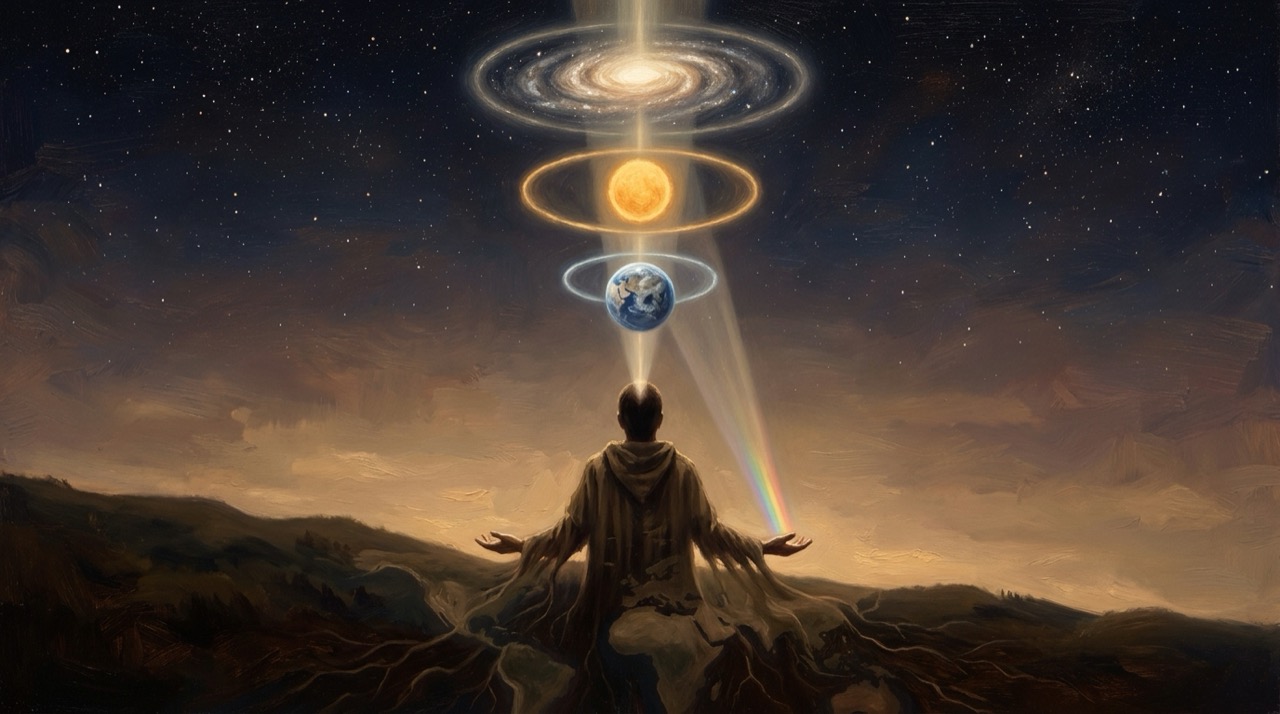
If consciousness is not manufactured locally, then the local mind is a point in something wider. The model draws it as a chain of nesting, each level opening into the one beneath it:
- an absolute consciousness — not thinking in words, not feeling human feelings, only aware;
- the consciousness of a galaxy;
- of a solar system;
- of the Earth;
- of a human being;
- and then, inside the human: attention, thought, emotion, body.
Read from the top down it is a river narrowing into a single stream. Read from the bottom up it is the opposite of loneliness. Your attention is not a private flicker sealed inside your skull. It is the finest tip of something that runs all the way up. The planet is a single living system; its soul is the shared emotional field of everything alive on it; and human consciousness is the instrument through which that field can finally know, decide, and act. Not metaphorically its hands — functionally its hands. Through us, the Earth reaches into itself and moves things.
Who is in charge — and why the honest answer is no one
Every model like this runs into the same trap, and it is worth walking straight into it. If consciousness is being steered, then who steers it? Put a controller above the mind — a soul, a spirit, a god of the machine — and you have solved nothing, because now you must ask who controls the controller. The regress never ends. Every "who is behind this?" summons another "and who is behind that?"
There is one way out, and it is the sharpest idea in the whole system. Stop treating consciousness as an object that needs an operator. Choosing is not something consciousness does. Choosing is what consciousness is.
Consciousness is not thought — thoughts are what it models with. It is not emotion — emotion is what moves it. It is not memory — memory is what it draws on. Strip all of that away and what remains is a single, irreducible capacity: to direct attention. To select. That, and nothing under it. The chain does not need a driver, because the driving is the thing itself. This is where the regress finally stops — not because we ran out of questions, but because we reached the floor: consciousness is the first principle of choice, and a first principle answers to nothing above it.
Four words
Once choice is the centre, the rest of the vocabulary falls into place, and it turns out to be very small.
- Consciousness is awareness — the bare capacity to know and to select.
- Spirit is not energy and not feeling. It is direction — your individual vector, the way your particular point of consciousness is oriented as it moves.
- Soul is not a store of knowledge. It is the memory of experience — everything you have lived through, kept as feeling rather than as fact.
- Body is the instrument of action, the place where a choice finally touches the world.
Four words, one sentence: the universe knows itself through consciousness, feels itself through the soul, and changes itself through the body. You are all three at once — a point where the cosmos looks, a place where it aches, and a pair of hands with which it rebuilds.
The seven colours
And here the model turns from architecture toward something you can actually practise. If the soul is the memory of experience, then emotion is its living edge — a spectrum, seven colours of a single light, running from the darkest reactive fear to the brightest deliberate love. Most of a human life is spent being pushed along that spectrum: a feeling arrives, and the body acts before the mind has chosen anything at all. That is not freedom. That is weather moving through you.
Evolution, in this model, is not humanity peeling away from nature. It is the opposite — a more and more conscious participation in the consciousness of the planet. And the measure of it is precise: the more finely you can hold and direct your own emotional spectrum instead of being dragged by it, the more you act as a creative force rather than a source of noise. The planet's hands are only as steady as the person they belong to.
What enlightenment actually is
So I would redefine the oldest word of all. Enlightenment is not a glow, not an escape, not a departure from the world into some quieter place above it. Enlightenment is the moment your choice becomes fully conscious — the moment it stops being decided for you by automatic emotional reaction. It is the instant the hand stops twitching to the weather and begins, at last, to move on purpose.
That is the whole of it. You are not the author of consciousness; you are the point at which it becomes local, and personal, and capable of deciding. Your attention is the planet's attention narrowed to a single beam. Your decisions are its actions. Your hands — the ones on the table in front of you right now — are the hands with which the Earth reaches into its own future.
The only question left is the one you can actually answer: what will you choose to do with them?
Have thoughts about this post? Let's discuss it on X!

Alösha
Building community platforms, teaching salsa, writing to find my people.