
Democracy Is Broken. Here's an Architecture to Fix It.
Combining liquid democracy, AI agents, and resource-based economics into a system where your values actually matter.
I have been thinking about politics lately. Not the kind where people yell at each other on television. The kind where you actually try to answer: how should seven billion people make decisions together?
And I think I found an interesting answer. It came from combining three ideas that nobody has connected before.
The problem with voting for strangers
Here is something that has always bothered me. In every election, I am asked to choose between people I have never met. People I know nothing about beyond curated speeches and campaign ads. I am supposed to trust them with healthcare, education, infrastructure, the environment.
Why?
I know a doctor. I know an engineer. I know a teacher. I know people who are actually good at these things, people I have known for years, people whose judgment I trust because I have seen it in action.
What if I could delegate my healthcare vote to my doctor friend? My infrastructure vote to my engineer friend? What if they could do the same with the topics they are not experts in?
This is called liquid democracy. You can vote directly on any issue, or you can delegate your vote to someone you trust, and they can delegate further. At any point, you can take your vote back.
It is not a new idea. An organization called Democracy Earth wrote a whitepaper about it back in 2017. They built a protocol, got into Y Combinator, and then went dormant around 2022.
But the idea is still powerful.
The missing piece: who has time for this?
The problem with liquid democracy is participation. Even if you can delegate, you still need to think about who to delegate to, on which topics, and when to override. Most people will not do this for two hundred decisions a year. Life is busy.
This is where AI changes everything.
What if you had a personal AI agent that knew your values? Not your opinions on specific policies, but your actual values. The things you care about deeply. The priorities you would choose if you had unlimited time and information.
What if that agent could vote on your behalf when you are busy, delegate to your trusted circle when the topic is outside your expertise, and alert you when something important comes up that needs your personal attention?
That is what I have been building with Ikigai Team. It starts with a coaching session, not a configuration file. An AI coach helps you reflect on what matters to you, scores ten areas of your life, and finds your direction. Then your AI team is calibrated to those values.
Right now it is a personal productivity tool. Six agents that help you manage your day. But underneath, it is a governance prototype.
Then I read Jacque Fresco
While researching governance models, I picked up "The Best That Money Can't Buy" by Jacque Fresco, the founder of The Venus Project.
Fresco asks a radical question: what if we stopped using money entirely and managed resources directly through technology?
His vision: a worldwide network of sensors monitoring everything from water tables to factory inventories. AI systems that allocate resources based on actual carrying capacity and human needs, not profit. Free access to everything, like a global library. No politics, no corporations, no poverty.
It sounds utopian. And his biggest blind spot is governance. He says "scientists and computers will figure it out." He dismisses democracy entirely, calling it an illusion within a monetary system.
He is right that current democracy is broken. But he is wrong that the answer is to remove humans from decisions entirely. Because someone has to define what "the common good" means. That is not a scientific question. It is a values question.
And that is where the three ideas connect.
Three layers, one system
What if we split governance into layers, and gave each layer to the system that handles it best?
Layer 1: Resource management. This is Fresco's domain. AI and sensors manage the logistics of resource allocation. How much water does this region have? How much energy is being consumed? Where should food production increase? These are objective, measurable questions. No human voting needed. Let the machines handle it.
Layer 2: Values and direction. This is where liquid democracy comes in. Humans still need to decide what we optimize for. Do we prioritize space exploration or ocean cleanup? Do we allow genetic modification? How much individual freedom versus collective efficiency? These are values questions. You delegate to people you trust, or to your AI agent, and the system aggregates everyone's values into priorities that guide Layer 1.
Layer 3: Personal sovereignty. This is the Ikigai Team layer. Your AI team is your interface to the whole system. It knows your values because it started with coaching. It participates in Layer 2 on your behalf. Layer 1 delivers resources based on your preferences. And you can override anything, anytime.
The flow looks like this:
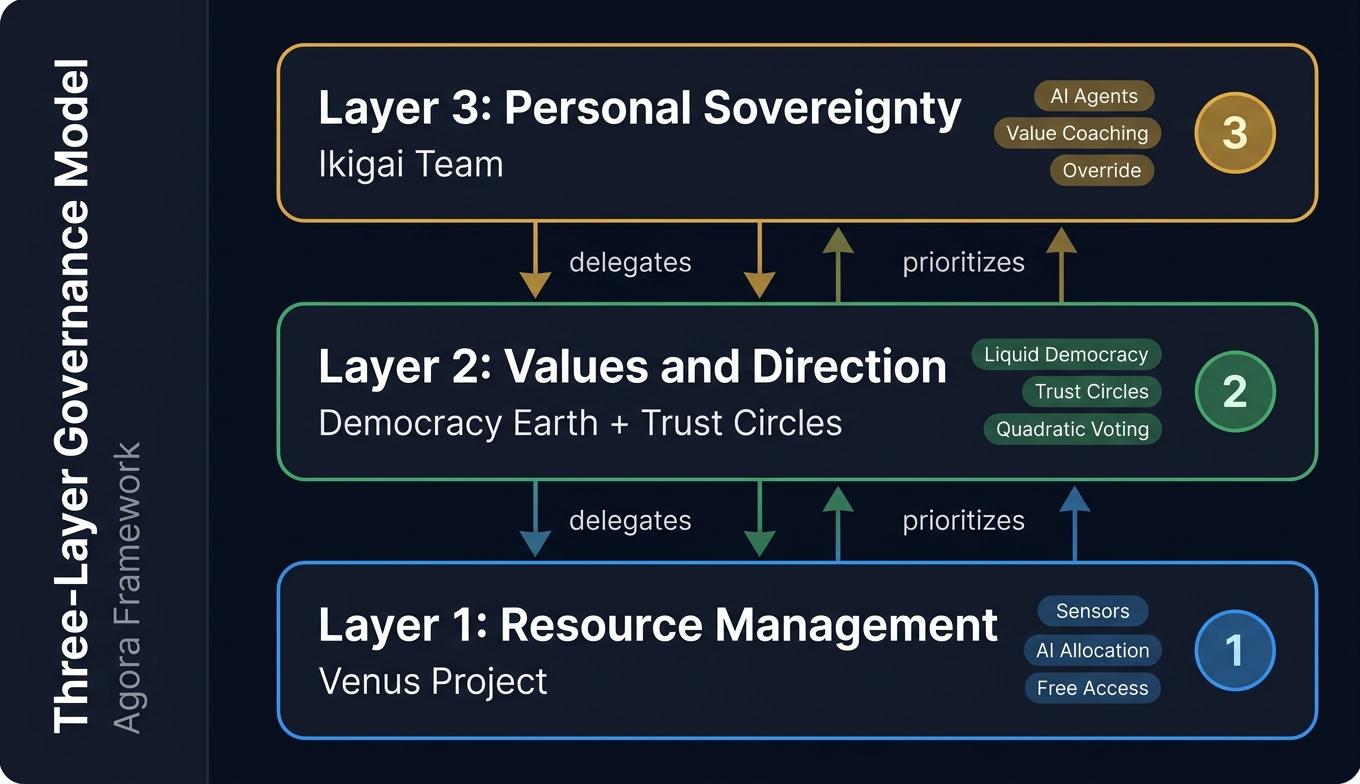
Your values → your AI agents → your trust circle → liquid democracy → aggregated priorities → resource management AI → allocation and production → free access to you.
The thread that holds it together
There is one value that makes this entire system trustworthy: radical openness.
If the resource management AI is a black box, you are back to technocratic control. If the voting protocol is proprietary, you cannot verify your delegation chain. If the agent code is closed, you cannot trust that your agent represents your values.
Everything must be open. Open-source code. Open research. Open protocols. Open governance documents. Creative Commons knowledge.
This is not idealism. It is engineering. Closed systems cannot be trusted with governance. Period.
Interestingly, this aligns across all three source systems. Sociocracy 3.0 calls it transparency. Fresco says that without money, there is no reason to keep secrets. Democracy Earth built everything open-source.
The transition
I am not proposing we overthrow anything. Here is the actual path:
- Now: Build the personal governance layer. Get people running their own AI teams calibrated to their values. This is Ikigai Team, and it already works.
- Next: Add trust circles. Let people delegate specific decisions to humans they actually know. Your doctor friend for health, your teacher friend for education.
- Then: Connect the circles. Enable liquid democracy across a network of personal AI teams. P2P, encrypted, verifiable. Like torrents, but for governance.
- Parallel: Start small resource experiments. Sensor networks in a community. Shared resource allocation. Prove that Layer 1 works at small scale.
- Converge: Connect the governance layer to the resource layer in a real community. Show that it works.
- Scale: Let results speak for themselves.
Each phase validates a hypothesis before moving to the next. If Phase 1 fails and people do not delegate to their agents, the later phases do not make sense.
Why this matters now
AI is accelerating faster than our governance systems can adapt. The decisions we need to make about AI safety, climate, automation, and resource distribution are getting more complex and more urgent. But our decision-making systems are stuck in a model designed for the eighteenth century.
We do not need to wait for a crisis. We can start building better governance infrastructure today, starting with something as simple as an AI team that actually knows what you care about.
I am calling this project Agora. The ancient Greek assembly where citizens came together to debate and decide. Not representatives. Not algorithms. Citizens.
But this time, with better tools.
I am building this in the open. The code is at github.com/razbakov/ikigai-team. The governance research is at agora.razbakov.com. If any of this resonates, I would love to hear from you.
Have thoughts about this post? Let's discuss it on X!

Alösha
Building community platforms, teaching salsa, writing to find my people.
You might also like
Severance, but for AI
Why personal and work avatars need separate memory, and why they should sometimes be allowed to talk.
I Built an Executive Team of 6 AI Agents to Manage My 15 Side Projects
How I use Claude Code to run an autonomous AI agent team that handles code review, content, strategy, coaching, and community across 15 projects while working full-time.
AI Secretary: What If You Let AI Tell You What to Do Next?
I stopped managing tasks in Jira and built an AI that knows my projects, my priorities, and my next move. Here's how it works and the seven rules I actually follow.