What Level of AI Are You On? From Q&A to Ikigai
Most people use AI to ask questions. But there are 10 levels of AI mastery — and the highest one has nothing to do with technology. A recap of Learn By Doing Academy Live Stream #1.
Most people use ChatGPT as a search engine replacement. That is Level 1. There are nine more levels after that, and the highest one has nothing to do with technology at all.
I ran the first live stream for Learn By Doing Academy on Saturday. What started as a casual walkthrough of AI tools turned into a 90-minute conversation about agents, recursion, philosophy, and finding your purpose. Here is what we covered.
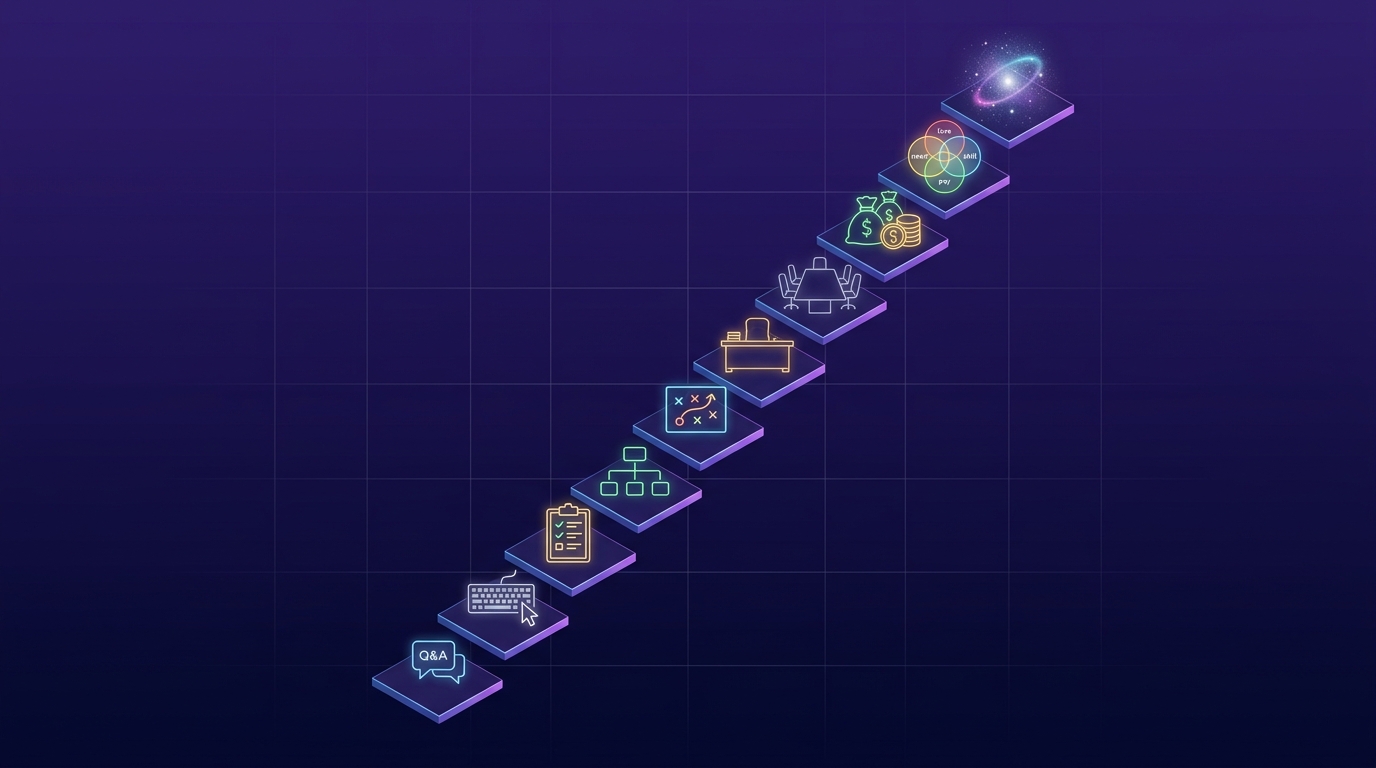
The 10 Levels of AI Mastery
I use a corporate hierarchy analogy to explain how people relate to AI. Each level is a shift in how much you delegate and how much you think.
Level 1 — Q&A. You ask ChatGPT questions. It is a smarter Google. Most people stop here.
Level 2 — Operator. You give AI tasks, not questions. "Write this email." "Summarize this document." Tools like Cursor live here.
Level 3 — Manager. You give projects to operators. You define outcomes, not steps. You start chaining prompts and using agents.
Level 4 — Division Manager. You prioritize across multiple projects. You decide what gets done first and what gets killed.
Level 5 — VP. Strategy. You are thinking about direction, not execution.
Level 6 — CEO. You set the vision. The entire system runs beneath you.
Level 7 — Board. You are evaluating the CEO. Governance over your own system.
Level 8 — Investor. You allocate resources across multiple systems. Portfolio thinking.
Level 9 — Ikigai. You have found the intersection of what you love, what the world needs, what you can be paid for, and what you are good at. This is not about AI anymore. This is about knowing yourself.
Level 10 — Quasi World. The quantum layer. The source of ideas. Flow states. The waterfall of thoughts that arrives before you can articulate them.
The point is not to rush to Level 10. The point is to know where you are and what the next step looks like.
What Is an AI Agent, Really?
We broke down the anatomy of an agent into four parts:
- System prompt — the role, responsibilities, what to do and what not to do. This is the identity.
- Model choice — Claude is better at creative and prompt-writing tasks. GPT Codex is better at structured task execution. Pick the right model for the job.
- Skills — reusable, composable prompts. Think of them as recipes the agent can follow.
- Tools — including the ability to run other agents. This is where recursion comes in. An agent that can launch agents is fundamentally more powerful.
I recommended CS50 as the foundational course for anyone who wants to understand recursion, which is the core concept behind agentic AI.
The Ikigai Philosophy
The Japanese concept of Ikigai sits at the intersection of four circles: what you love, what the world needs, what you can be paid for, and what you are good at.
I think about it as the tension between the Heart (the child inside you that wants) and the Head (the parent that executes). Great work happens when both are aligned.
We went deep into the philosophy — duality, creation and destruction, the connection to quantum thinking. The "waterfall of thoughts" is that flow state where ideas arrive faster than you can type. AI is the tool that finally lets you capture them.
Web100 Project Demo
I showed the Web100 project — the idea of building 100 websites for 100 local businesses. We walked through a real example: a Thai massage salon redesign done entirely by AI agents on autopilot.
The demo included:
- A decision tree for service selection
- A sales pitch deck (normally 1000 EUR, special rate of 100 EUR)
- Discussion on cold outreach strategies and cultural considerations for approaching small businesses
Other Projects We Discussed
- Mystery Games — Mafia game nights in Munich
- 15x4 Munich — 15-minute educational talks (always looking for speakers)
- Montuno Club — salsa classes with QR code check-in and multi-language support
Join Learn By Doing Academy
If this kind of conversation interests you, the academy is open:
- Community (29 EUR/mo) — recordings, Telegram group, Q&A access
- Live (79 EUR/mo) — weekly private sessions, Discord project channels
- Mentorship (200 EUR/mo) — monthly 1-on-1 calls, code reviews, career guidance
Start with a free 15-minute discovery call to see if it is a fit.
Watch the Full Stream
The entire 90-minute conversation is on YouTube. If you want the unfiltered version with all the tangents, philosophy, and live demos, watch it here:
Have thoughts about this post? Let's discuss it on X!

Alösha
Building community platforms, teaching salsa, writing to find my people.
Related Projects
You might also like
I Built an Executive Team of 6 AI Agents to Manage My 15 Side Projects
How I use Claude Code to run an autonomous AI agent team that handles code review, content, strategy, coaching, and community across 15 projects while working full-time.
AI Secretary: What If You Let AI Tell You What to Do Next?
I stopped managing tasks in Jira and built an AI that knows my projects, my priorities, and my next move. Here's how it works and the seven rules I actually follow.
Severance, but for AI
Why personal and work avatars need separate memory, and why they should sometimes be allowed to talk.