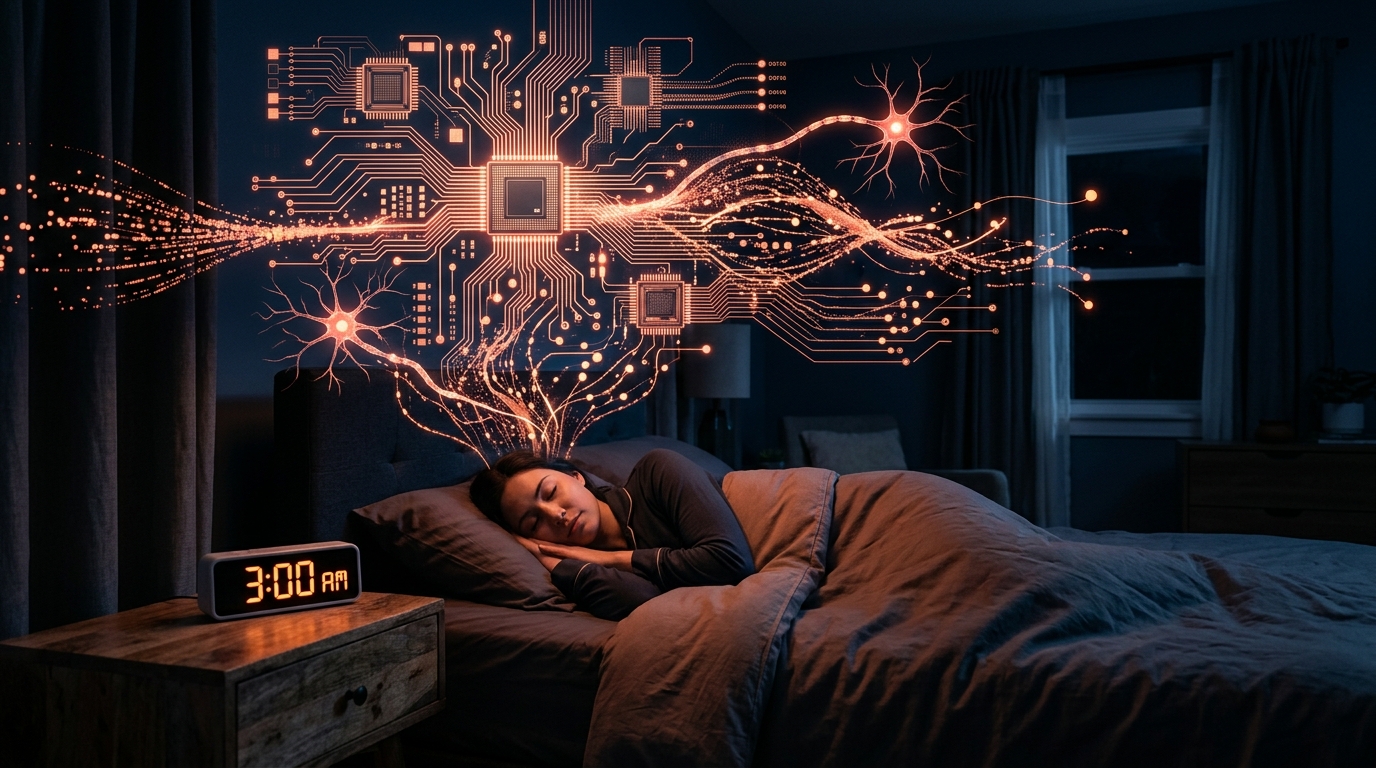
Your Brain Has a Night Shift: Dreaming as Extra GPU Compute
What if dreaming isn't random noise — but your brain offloading heavy computation to a freed-up GPU? The science of sleep incubation, hypnagogia, and why the best ideas come at 4 AM.
I woke up at 4 AM with a thought fully formed in my head: What if dreams are extra GPUs?
Not metaphorically. Not "dreams are like computers." I mean: what if the brain literally reallocates compute resources when you fall asleep — the way a server farm shifts GPU capacity from rendering to training jobs during off-peak hours?
During the day, your brain runs the most demanding real-time application imaginable: reality. It processes millions of sensory signals per second — light, sound, touch, balance, temperature — and reconstructs a seamless 3D world in real time. It runs motor control, language processing, social prediction, and threat detection, all simultaneously. That's an enormous compute load.
Then you close your eyes. Sensory input shuts down. Motor output goes offline — your body is literally paralyzed during REM sleep. All those neural circuits that spent the day rendering reality? They're now free.
And the brain doesn't waste them.
The Numbers Don't Lie
Here's what surprised me when I dug into the research: REM sleep consumes as much energy as being fully awake. During REM, your neurons fire at the same intensity as during waking hours. NREM sleep only drops to about 85% of waking energy consumption.
Your brain is not resting during sleep. It's running a different workload.
During the day, most of that energy goes to processing sensory input and generating motor output — what we might call the "reality rendering pipeline." At night, with the senses gated and the body paralyzed, that energy gets redirected. The brain shifts from real-time rendering to batch processing: consolidating memories, pruning weak synaptic connections, and — this is the interesting part — running simulations.
Antti Revonsuo, a Finnish neuroscientist, proposed that dreams function as a virtual reality simulation engine. His research found that "dreaming about an action is an identical process for cortical motor areas as actually carrying out the same action." The brain isn't producing random noise. It's generating a full perceptual world internally — without any external input. It's running compute-heavy simulations using the same hardware that renders reality during the day.
That's a GPU context switch.
Prompt Engineering for Dreams
Here's where it gets practical. If the sleeping brain really is running freed-up compute on internal problems, can you choose which problems it works on?
Yes. It's called sleep incubation, and it's been studied for decades.
A 2021 study published in Science Advances found something remarkable. Participants who spent just 15 seconds in the first stage of sleep (N1, also called hypnagogia) were three times more likely to discover a hidden mathematical rule than those who stayed awake — 83% versus 30%. The catch? This benefit vanished if they fell into deeper sleep. The sweet spot was right at the edge.
Edison knew this. So did Tesla, Salvador Dali, and Edgar Allan Poe. They each practiced the same technique: hold a steel ball (or a key, or a spoon) while dozing off. The moment you cross into sleep and your muscles relax, the object drops, the clatter wakes you, and you capture whatever your mind was computing in that liminal state.
In 2021, researchers at the Paris Brain Institute proved Edison was right. The technique works. That brief window of hypnagogia — when theta waves replace alpha waves — is what they called "a creative sweet spot."
But it goes deeper than hypnagogia.
A 2026 study from Northwestern University showed that playing sound cues associated with unsolved puzzles during REM sleep doubled the participants' success rate at solving those puzzles after waking — from 20% to 40%. The brain wasn't just idling during dreams. It was actively working on the problems it had been primed with. The sound cues didn't teach anything new — they just directed the sleeping brain's compute toward specific problems.
That's prompt injection for dreams.
MIT Built the Hardware
The MIT Media Lab took this idea to its logical conclusion with Dormio — a wearable device that detects when you're falling asleep and whispers targeted prompts during hypnagogia. They call it "Targeted Dream Incubation." The device monitors your biosignals, catches the exact moment you enter N1 sleep, plays an audio prompt ("think about a tree"), then gently wakes you to report what you dreamed.
The results? Participants who received targeted prompts produced measurably more creative output than controls. The prompts didn't just influence dream content — they enhanced the creative quality of post-sleep work.
Dormio is open-source. You can build one. We're entering an era where "prompt engineering" applies to both AI models and sleeping brains.
The Night Shift Architecture
If I were to diagram what happens during a full night of sleep in system architecture terms, it would look something like this:
N1 (Hypnagogia) — Job Initialization. Loosely associated ideas start firing. The brain transitions from focused, sequential processing to diffuse, associative mode. Alpha waves give way to theta. This is where Edison caught his insights. Duration: minutes.
NREM (Deep Sleep) — Defragmentation. Slow cortical oscillations sweep through the brain, enabling synaptic maintenance. The synaptic homeostasis hypothesis suggests this phase downscales overall neural firing rates — essentially garbage collection. Weak connections get pruned, strong ones get reinforced. The system gets cleaned up for the next computation cycle.
REM (Dreaming) — Full GPU Compute. The brain fires at waking intensity. It runs unconstrained simulations — combining memories, testing scenarios, discovering connections that conscious thought would never allow. This is where Kekule saw the snake eating its tail and realized benzene forms a ring. Where Mendeleev saw the periodic table arrange itself. Where Otto Loewi dreamed the experiment that won him a Nobel Prize.
The cycle repeats every 90 minutes, with REM periods getting longer toward morning. Your most powerful compute sessions happen in the last hours of sleep — which is why cutting sleep short doesn't just make you tired. It cuts off your most productive processing time.
A Practical Protocol
Based on the research, here's how to use your brain's night shift intentionally:
1. Prime the problem. Don't just think about it — engage with it actively for 15-30 minutes before bed. Write about it. Sketch it. Code a partial solution. The more deeply you engage, the stronger the memory trace that sleep will work on.
2. Compress it into a prompt. Distill the problem into one clear question or vivid image. Write it down on paper next to your bed. This is your "system prompt" for the night's compute.
3. Release. Stop trying to solve it. The conscious mind needs to let go so the diffuse, associative processing of sleep can take over. Trying to force a solution keeps you in focused mode — the opposite of what you need.
4. Capture immediately. Keep a notebook, phone, or voice recorder within arm's reach. The moment you wake — especially from a dream — record everything before it fades. Dream content decays within minutes.
5. Morning review. Within five minutes of waking, before checking email or social media, review what you captured. The connections are often fragile — one distraction and they're gone.
The Bigger Picture
I've been thinking about this in the context of something I wrote about recently — the Thought Waterfall, that state where ideas cascade faster than you can catch them. Many of my Thought Waterfalls start at 3-4 AM, right after a long REM period. The brain has been running batch compute all night, and the results start surfacing the moment consciousness comes back online.
There's a parallel to AI here too. During the day, I use Claude as external compute — an AI co-pilot that extends my cognitive capacity. At night, my brain becomes its own co-pilot, running the same kind of creative recombination and pattern matching, just on internal data.
We're living in an era where compute is the bottleneck — for AI models and for human brains. The difference is that we already have extra compute capacity built in. We just call it dreaming, and most of us waste it.
Eight hours of sleep isn't downtime. It's a second shift.
Have thoughts about this post? Let's discuss it on X!

Alösha
Building community platforms, teaching salsa, writing to find my people.
You might also like
Thought Waterfall: When Ideas Arrive Faster Than You Can Catch Them
There's a state where one idea triggers the next, which triggers the next, and suddenly you're drowning in connections. I call it Thought Waterfall. Here's how free writing and AI sub-agents trigger it — and how it differs from flow.
Dancing With AI: What If the Best Interface Is Your Body?
One monitor isn't enough. I need space to think — real, physical space. What if the next interface isn't a screen but a dance floor where prompts are spells and movement is meaning?
AI Secretary: What If You Let AI Tell You What to Do Next?
I stopped managing tasks in Jira and built an AI that knows my projects, my priorities, and my next move. Here's how it works and the seven rules I actually follow.